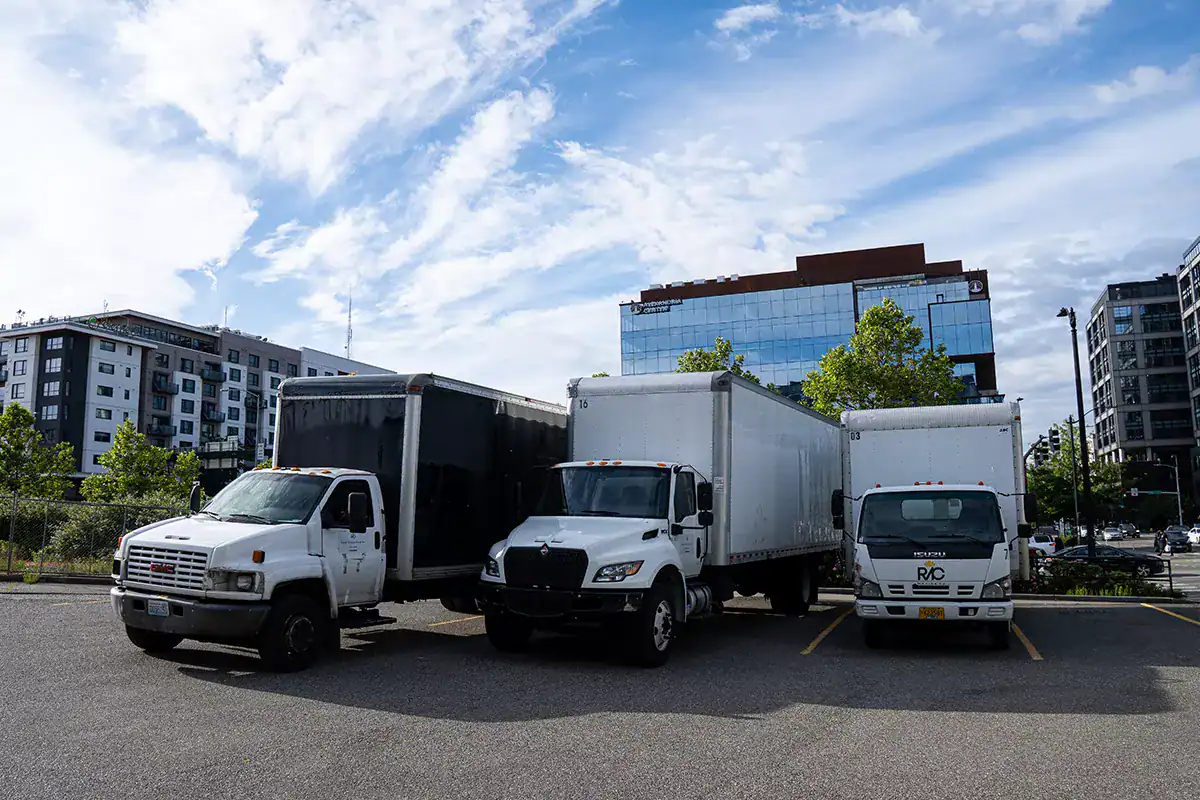
Every server move is a bet against the clock: the maintenance window opens, the racks must travel, and the systems must come back before the business notices. We move data centers, server rooms, and IT infrastructure on engineered runbooks: asset-tagged, anti-static, shock-protected, and sequenced to your IT team's cutover plan to the minute. The runbook covers staging, transport, and reinstallation order, and your change board sees it before approving the window.
Your IT team owns the logical migration; we own the physical one, and the two run on a single shared timeline.
The Physical Layer of a Migration, Done to Spec
IT teams plan migrations in meticulous detail and then discover the physical leg, the part where six figures of hardware actually crosses town, is the least controlled step in the runbook. Royalty Moving & Storage closes that gap: every device is asset-tagged and logged before disconnection, cabling is photographed and labeled to the port, racks travel braced or equipment travels in anti-static, shock-protected packaging, and the unload sequence mirrors your rack elevation plans so reinstallation is mechanical rather than archaeological. Hardware refreshes ride the same system: old equipment out to disposal or resale channels, new equipment staged in, one inventory tracking both directions.
The work happens inside your maintenance window, nights, weekends, holiday freezes, with both facilities' access, security, and loading logistics cleared in advance. Decommissions, consolidations, colo migrations, and office server-room moves all run the same way, scaled to the rack count. Your engineers handle the logical layer; ours make sure the physical layer never becomes the incident report. Small server rooms get the same discipline as full data halls; the runbook just gets shorter, not sloppier.
Six controls on every server and infrastructure relocation we run. Six controls, one outcome: hardware that powers on at the destination exactly as the migration plan assumed.
Asset-Tagged Inventory
Every server, switch, and appliance logs against your asset register before it unplugs, and reconciles after it lands.
Port-Level Cable Documentation
Cabling is photographed and labeled before disconnection, so reconnection follows a record instead of memory. The photo set rides with the runbook, so the night crew never guesses.
Anti-Static, Shock-Safe Transport
ESD-safe packaging, shock protection, and braced rack transport defend hardware that prices by the unit, not the pound. Transport routes avoid the potholes and rail crossings that shock sensors remember.
Maintenance-Window Execution
The move runs inside the window your change board approved: nights, weekends, and freeze periods are the norm.
Elevation-Plan Unloading
Equipment unloads in rack-elevation order at the destination, so reinstallation is assembly, not a puzzle.
Security and Access Control
Escorts, badge protocols, and both facilities' security requirements are arranged before the first cart rolls. Visitor logs and escort requirements are satisfied before the window, never negotiated during it.
Four stages aligned to your migration plan. Dry-run walkthroughs are available for high-stakes windows, because rehearsed moves run faster than confident ones.
01
Asset and Site Survey
Inventory the hardware, walk both facilities, and align with your migration plan.
02
Runbook and Cost
A sequenced physical-move runbook and one flat written cost, mapped to your window.
03
Window Execution
Tag, document, pack, transport, and stage exactly to the approved sequence.
04
Reconcile and Hand Off
Assets reconciled against the register, hardware staged to elevation, your team cuts over.
IT crews serve server rooms, colocation facilities, and corporate infrastructure across the metro's tech corridors. Colo-to-colo, office-to-colo, and consolidation moves between corporate sites are the three most common shapes of this work.
Hardware survives either way, usually. The migration timeline does not. The hardware usually survives the improvised version; the cutover deadline usually does not.
Typical Movers
The improvised move
Servers stacked like office boxes
Cables cut loose with labels promised later
The window blown by dock surprises at 2 AM
Assets reconciled by walking around counting
Static and shock treated as superstition
Royalty Moving & Storage
The runbook move
ESD-safe, shock-protected, braced transport
Port-level photo documentation before unplugging
Access and docks cleared before the window opens
Register reconciliation built into the sequence
The physical leg as controlled as the logical one
Included With Data Center Moving
The physical-layer standard, in writing.
Asset Logging
Tagged and reconciled against your register.
Cable Documentation
Photographed and labeled to the port.
Protected Transport
Anti-static packaging and braced racks.
Window Discipline
Executed inside the approved change window.
Elevation Staging
Unloaded in reinstallation order.
Licensed and Insured
Washington UBI #605117720 and permit THG070945.
Make the Physical Leg the Boring Part of the Migration
One survey, one runbook, one flat cost, and a window that closes on time. Change boards approve faster when the physical leg arrives as a document instead of a promise.
1. How much does a server or data center move cost?
Rack count, hardware density, and window constraints set the number. The survey produces one flat written cost mapped to your maintenance window, which is what the change-approval paperwork needs anyway.
2. Do you move racks whole or piece by piece?
Whichever the hardware and the route allow: populated racks travel braced where weights and access permit; otherwise equipment de-racks into protected packaging and reinstalls to your elevation plans. The survey decides honestly. Lift gates, ramps, and server lifts are part of the equipment plan either way.
3. Can you work inside our overnight maintenance window?
That is the default condition of this work. Crews stage before the window opens, execute inside it, and the schedule is built backward from your cutover time. If the window compresses mid-job, the runbook’s sequence makes triage decisions fast and rational.
4. Who handles disconnection and reconnection?
Your IT team or vendor owns the logical layer and final reconnection; we document everything physical, cables photographed and labeled to the port, so their reconnection follows a record.
5. What about chain of custody for sensitive hardware?
Every asset moves against the tagged inventory with sign-offs at each handoff, and security escorts and badge protocols at both facilities are arranged in advance. Drives and sensitive media can travel under your custody rules where policy requires.
6. Can hardware stage in storage between facilities?
Yes: secure, access-controlled holding for phased migrations, with the asset register tracking exactly what is where. Call (206) 278-2134 to scope a phased plan. Staged hardware remains on the asset register with its location tracked throughout the hold.
7. Are you insured for high-value IT moves?
Yes. Royalty Moving & Storage operates under Washington UBI #605117720 and household goods permit THG070945, with declared-value coverage appropriate to hardware that costs more than the truck carrying it.