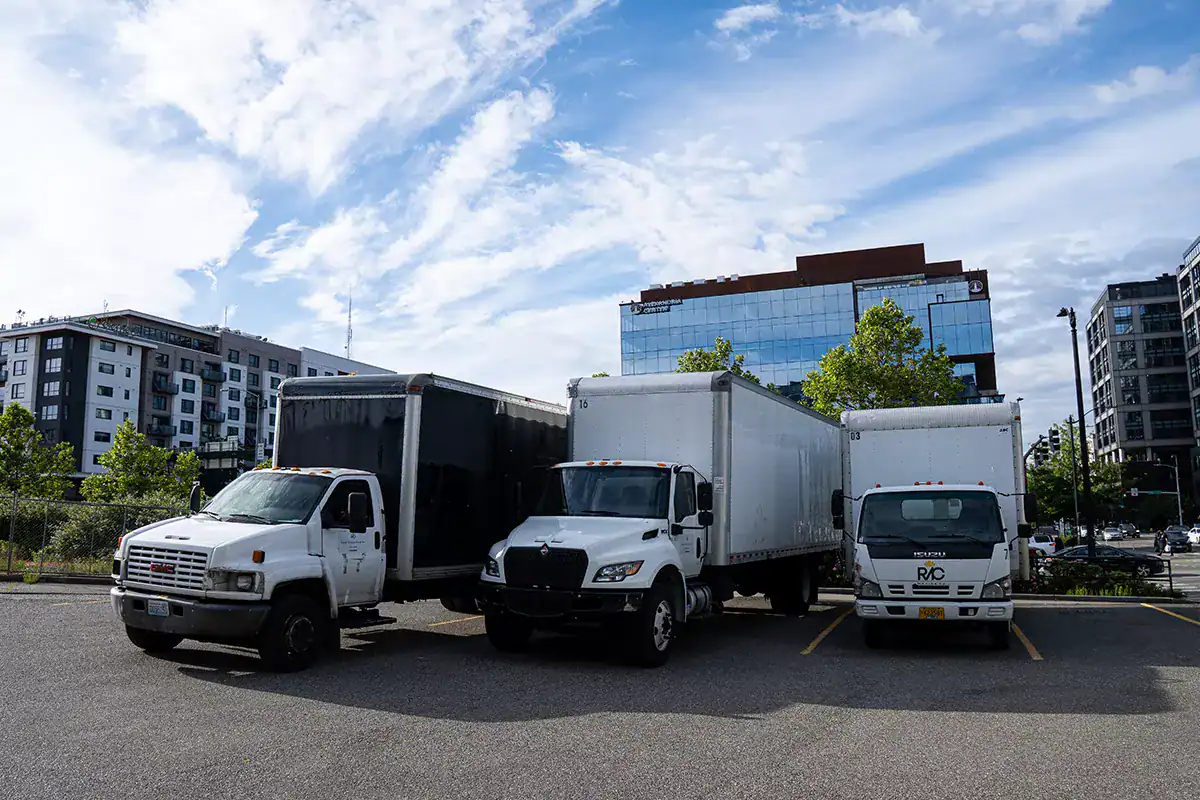
Moving a financial institution is a security operation with furniture attached. Branches, back offices, and credit unions relocate under controls most movers have never heard of: background-checked crews, dual-custody handling, coordination with your security officers, and a plan that assumes scrutiny because scrutiny is the industry. The same controls scale down to advisory offices and credit union branches, because the obligations do not shrink with the square footage.
Every step is documented, every handoff is signed, and every crew member on the job was vetted before learning the address.
Financial Institutions Move Under Different Rules. So Do We.
A branch relocation touches everything regulators and security teams care about: customer records, secure equipment, cash-handling infrastructure, and the institution's obligation to reopen on the announced date because trust is the actual product. Royalty Moving & Storage runs these projects to that standard: background-checked crews assigned per engagement, sequencing planned with your security officer, sensitive materials moved under dual custody with signed transfer records, and after-hours execution so the branch closes Friday and opens Monday with the institution's composure intact. Branch consolidations, where two locations become one, add a sorting layer: what merges, what stores, and what retires, all of it documented to the same standard.
The heavy specialty work is planned with the right partners: vault doors, safes, and safe-deposit infrastructure involve weights and rigging coordinated with specialist trades, while teller lines, secure cabinets, ATMs' surrounding furniture, and the branch's complete working environment move under our direct control. Document handling runs chain-of-custody throughout, with compliant storage available where consolidation leaves records between homes. ATM-adjacent infrastructure, signage, and the branch's customer-facing environment move on the same controlled schedule, so the new location opens looking like the institution, not like a move.
Six controls every financial relocation here runs under. Every control answers a question an examiner or security officer might ask; the move file holds the answers.
Vetted Crews
Background-checked movers assigned by name to the engagement, briefed under your security officer's protocols.
Dual-Custody Handling
Sensitive materials move under two-person integrity with signed transfer records at every handoff. The records survive the move; so does the proof of how they moved.
Security-Officer Sequencing
The move plan is built with your security team, not shown to them afterward, and follows their order of operations.
Records Chain of Custody
Customer files and documents travel sealed, inventoried, and signed across the entire path. Retrieval order is preserved, so the first Monday request finds its file.
Heavy Secure Equipment
Safes, vault-adjacent infrastructure, and secure cabinets move with engineered rigging plans and specialist coordination.
Weekend Reopen Discipline
Close Friday at the posted hour, open Monday at the posted hour: the announced dates are commitments, not estimates. Customer-facing communication can promise dates because the plan can keep them.
Four controlled phases from approval to reopening. Crew rosters and identification go to your security office ahead of the engagement, not at the door.
01
Security-Led Survey
Both sites walked with your security and facilities leads; constraints documented.
02
Controlled Plan
Sequencing, custody protocols, crew assignments, and a flat written cost.
03
After-Hours Execution
Vetted crews move the institution inside the closed window, every handoff signed.
04
Audit-Ready Close
Reconciled inventories and the complete move file delivered for your records.
Financial crews serve banks, credit unions, and advisory offices across the metro's commercial districts. Multi-branch programs run under one accountable plan, with each location's controls intact. Branch networks of any size run on the same controls, location by location.
Institutional Controls vs. A Commercial Move With a Tie On
The difference is what happens when someone asks to see the records. The institutional move costs marginally more and protects immeasurably more, which is the entire risk calculus.
Typical Movers
The standard commercial move
Crews unknown to anyone's security office
Records boxed loose and tracked on faith
Sensitive items handled solo, witnessed by nobody
A reopening date treated as a soft target
No file to produce when compliance asks
Royalty Moving & Storage
The institutional move
Background-checked crews named in advance
Sealed, inventoried, signed records transport
Dual custody on everything that warrants it
Posted hours honored at both ends
An audit-ready move file at close-out
Included With Bank Relocation
The institutional standard, documented. Each line maps to a control your examiners would recognize, and each appears in the engagement documentation by name.
Vetted Crews
Background-checked and assigned by name.
Custody Protocols
Dual-integrity handling with signed records.
Security Coordination
Planned with your officers from day one.
After-Hours Windows
Closed-hours execution as the default.
Audit File
Complete documentation at close-out.
Licensed and Insured
Washington UBI #605117720 and permit THG070945.
Relocate the Institution Without Spending Its Trust
One security-led survey produces a controlled plan, vetted crews, and posted hours that hold. The first conversation can include your security officer from minute one, which is usually how institutions prefer it.
Like the controlled project it is: the security-led survey produces one flat written cost covering vetted crews, custody protocols, after-hours execution, and documentation. Institutions prefer committed numbers, and so do we.
2. Do you move cash, negotiables, or vault contents?
No, and any mover who says yes should worry you: those move under your institution’s armored-carrier and security procedures. We move everything around them, precisely sequenced according to your security officer’s plan. The sequencing simply builds around the armored schedule, the same way it builds around your security officer’s other requirements.
3. Can you relocate safes and heavy secure equipment?
Yes, with engineered rigging plans and specialist coordination where the weights demand it. Floor loading, route reinforcement, and placement are surveyed before anything is committed.
4. How do you handle customer records?
Sealed, inventoried, and signed at every transfer: chain of custody runs unbroken from the old branch to the new one, or into compliant document storage where consolidation requires it. Retention-expired records identified during the move can route to certified destruction with documentation, closing two projects at once.
5. Can the branch really close Friday and open Monday?
That is the standard pattern: posted hours hold at both ends, the move executes inside the closed window, and your team walks into a working branch. Call (206) 278-2134 to scope the dates.
6. Will your crews pass our vendor security screening?
Yes: crew identities are provided in advance for your vetting, background checks are standard for these engagements, and your security protocols govern on site.
7. Are you licensed and insured for institutional work?
Yes. Royalty Moving & Storage operates under Washington UBI #605117720 and household goods permit THG070945, with the commercial coverage and documentation your procurement and compliance teams will ask for.