Getting to Know Paramount
How Paramount Sits
Paramount is an independent city in southeastern Los Angeles County, in the cluster of Gateway Cities about twelve miles southeast of downtown Los Angeles. Because Paramount is its own city, it sets its own rules on truck access, oversized vehicles, and permits. It is a general-law city, incorporated in 1957. It is small and densely built, covering about 4.7 square miles of land with more than 53,000 residents.
The land is flat and fully developed, a tight grid of residential streets, commercial corridors, and industrial pockets. Paramount Boulevard, the north-to-south street that gave the city its name, is the main spine, with Rosecrans Avenue and Alondra Boulevard among the other key routes. The 710 and 105 freeways run nearby. Paramount borders Compton and Lynwood to the west and South Gate and Downey to the north. Bellflower lies to the east and south, with Long Beach to the south.
The housing is mostly modest postwar single-family homes on small lots. Apartments fill in along the busier corridors and near the commercial streets. The population is dense, young, and largely Latino, with a long-established African American community as well. Households are often large and multi-generational, which shows in a high number of people per home. Industry still has a place here, most famously the Zamboni company. It has built its ice resurfacing machines in Paramount for decades.
From the Hay Tree to the City of Paramount
The land was home to the Tongva people. Under Spanish and Mexican rule, it became part of Rancho San Pedro, the vast grant held by the Dominguez family, whose patriarch later signed the California Constitution. After American statehood, the area was farmed. By the early twentieth century the twin villages of Hynes and Clearwater had become the heart of Southern California’s dairy industry, known as the Milk Shed of Los Angeles.
This was hay and dairy country on a remarkable scale. At its peak the area held some twenty-five thousand cows, more per square mile than anywhere west of Chicago. It was called the World’s Largest Hay Market. Every working morning, hay traders gathered under a camphor tree to set the price of hay. The numbers they agreed on were quoted by the New York markets as the global standard. That tree, the Paramount Hay Tree, still stands and is a California Historical Landmark.
The modern city came together in stages. In 1948, the post offices of Hynes and Clearwater were merged. The combined community took the name Paramount from Paramount Boulevard, the main street running through it. Frank Zamboni, the local businessman who invented the ice resurfacing machine, helped propose the name. In 1957, a campaign called Save Paramount for Paramount fought off annexation by Long Beach, Bellflower, and South Gate. The city incorporated on its own that year. The dairies faded as land grew too valuable for cows, and the last one closed in 1977. Paramount grew into the dense residential and industrial city it is today.
What a Paramount Move Really Involves
Paramount is an independent city, so a move here works under City Hall rather than the county or the City of Los Angeles. For larger moves, the city issues temporary no-parking permits that hold curb space at the address, and our office arranges and posts these in advance. In a city this dense, that permit is often the difference between parking at the door and carrying from down the block, so we file for it early on the busiest streets.
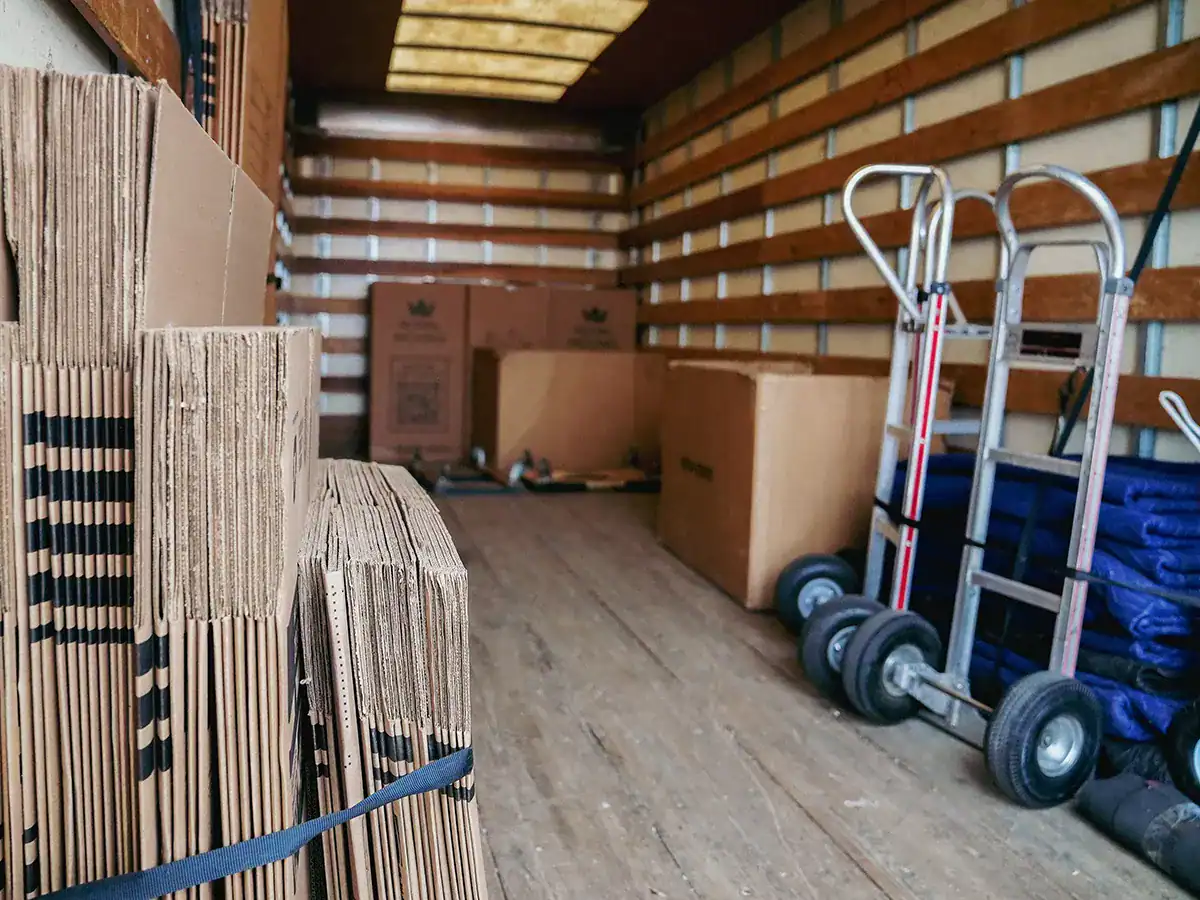
The density and the households shape most of the work. Paramount packs its residents into a small, flat grid, and parking is tight on many streets. Many homes hold large, multi-generational families with more furniture and belongings than the floor plan suggests. We size the crew and the truck to the actual load rather than the room count. We map the parking and the carry before the day. Apartment moves bring stair carries, parking permits, and building move-in rules. We handle all of that with management ahead of time.
The single-family homes are more straightforward, mostly postwar houses on small lots with driveways and garages. We plan those around the driveway and the street. For the business moves in Paramount’s commercial and industrial pockets, we work around operating hours and handle the loading and access. With the permit, the parking, and the access settled before move day, nothing slows the job once the crew arrives.