Getting to Know South Gate
How South Gate Sits
South Gate is a city in southeast Los Angeles County, about seven miles southeast of downtown Los Angeles. It covers roughly seven and a half square miles and had about 92,700 people at the 2020 census, which makes it one of the most densely populated cities in the county. It is one of the Gateway Cities, and it borders Lynwood, Downey, Huntington Park, Cudahy, Bell, and South Los Angeles. The Los Angeles River and the 710 Freeway run along its southeastern edge.
The city is mostly residential and working-class, with a large Latino majority. The homes are modest, many built in the housing boom of the 1940s and 1950s, and a good share are duplexes and triplexes. Tweedy Boulevard carries the main commercial district, the Tweedy Mile, with about three hundred mostly family-owned businesses, and the city hosts a well-known Cinco de Mayo parade there each year. The Firestone Boulevard corridor and the El Paseo center hold more shops and chain retailers. South Gate Park, at nearly 97 acres, is the city’s largest green space.
South Gate is known as the Azalea City, a name it adopted with the flower as its symbol in 1965, and it still holds an annual Azalea Festival at South Gate Park. The Hollydale neighborhood in the southeast, separated by the river and the freeway, is a community of its own within the city. The result is a dense, family-centered city with deep working-class roots and a strong sense of community.
From Danish Dairies to the Azalea City
The land was home to the Tongva people and later part of the Mexican Rancho San Antonio. In the late nineteenth and early twentieth centuries, it was farm country, with dairies run by Danish immigrant families and vegetable and fruit fields. The Tweedy family, who came west by ox-drawn cart in the 1850s, owned about 2,000 acres of the land that became the city, and the main shopping district still carries their name.
Subdivision began in the 1910s and 1920s, and the area was first laid out as South Gate Gardens, named for a section of the old Cudahy Ranch. In 1923, with a small population, residents incorporated as the city of South Gate. The Firestone Tire and Rubber Company built a factory on a former bean field; a foundry and a chemical plant followed, and jobs and cheap housing drew workers in.
Industry defined the next half century. General Motors opened its South Gate Assembly plant in 1936, building cars on Tweedy Boulevard until it closed in 1982. The factories drew waves of workers, and after the plants closed, the city’s economy and population shifted, growing into the dense, largely Latino community it is today. The old auto plant site is now Southeast High School.
What a South Gate Move Really Involves
South Gate is dense and mostly residential, so most moves here turn on access and tight streets rather than distance. We begin by settling where the truck parks and how each item gets to it. On the residential blocks, that means small lots, narrow driveways, and multi-unit homes with shared entrances. On the commercial corridors, it means loading zones that fill during business hours. In Hollydale it means planning around the river and freeway crossings. We nail down the parking and the access well before the day.
The home is what we look at next. A small bungalow has a narrow path from the curb and a tight porch. A duplex or triplex has a shared entrance, a stairwell, and neighbors whose space we work around. A unit upstairs needs the stairs and landings protected. We check the unit, the stairs, and the carry distance ahead of time, and bring the protection and the crew size to match.
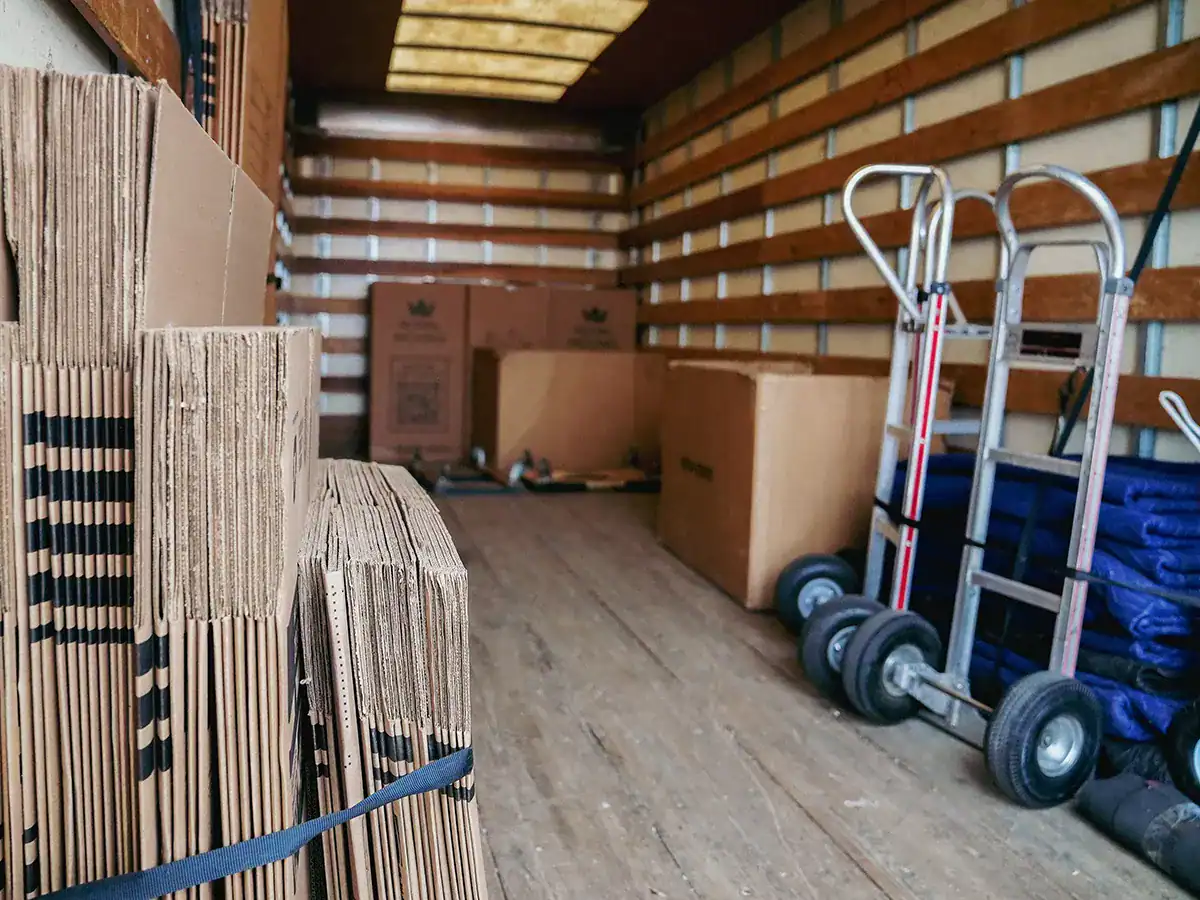
The third piece is what is actually being moved. A single-family bungalow, a unit in a triplex, a shop on Tweedy, and a full multigenerational household each call for a different plan. A South Gate home often holds a full multigenerational household, so the load runs heavier than the floor plan hints. We lay down door, railing, and floor protection as a matter of course, and we plan the handling for fragile and valuable pieces ahead of time. With the parking, the home, and the handling locked in beforehand, the crew works without stalling once it arrives.