Getting to Know Lakewood
How Lakewood Sits
Lakewood is an independent city in southeastern Los Angeles County. It sits about fourteen miles south of downtown Los Angeles. It covers about 9.4 square miles and holds about 82,496 residents. That works out to a density of around 8,775 people per square mile. Lakewood is best known for the Lakewood Plan, the contract-city model it pioneered. Under that model, the city contracts with Los Angeles County for most municipal services. The Sheriff’s Department provides law enforcement. The county handles fire, road maintenance, libraries, and other services. City hall sits on Clark Avenue. A small full-time staff coordinates the rest. Because Lakewood is its own city, it still sets its own rules on truck access, oversized vehicles, and permits.
Lakewood Boulevard, Carson Street, Candlewood Street, and Del Amo Boulevard are among the main routes through the city. The San Gabriel River Freeway, Interstate 605, runs along the eastern edge. The 91, the 405, and the 22 are all within a few minutes. Lakewood borders Long Beach to the south, Bellflower to the north, and Cerritos to the east. The unincorporated community of Hawaiian Gardens sits immediately east of Cerritos.
The housing is overwhelmingly single-family and owner-occupied, with about 72% of homes owned by their occupants. The household average runs around 3.0 people, and the population reflects long-tenured families. The demographic mix today is genuinely diverse, with significant Latino, Asian, White, and Black populations.
From Bean Fields to Instant City
The land was home to the Tongva people, and through the Spanish and Mexican eras, it sat within the holdings of the Lugo family and the Rancho Los Cerritos and Rancho Los Coyotes grants. In 1934, Clark J. Bonner of the Montana Land Company and promoter Charles B. Hooper subdivided land in the area and named it Lakewood Village. The name came from Bouton Lake, a small body of water created by an artesian well that oil drillers had accidentally opened. The community remained small through the late 1940s.
The story changed in 1950. The Lakewood Park Corporation, headed by Louis Boyar, Ben Weingart, and Mark Taper, purchased 3,500 acres of bean fields north of Long Beach. They laid out a master-planned community of 17,150 tract homes. The homes were built using mass-production techniques and the standardized parts that postwar Southern California construction had perfected. Finished homes came off the line at a peak rate that earned Lakewood its nickname as the instant city. The Lakewood Center shopping mall opened in 1951, one of the earliest enclosed shopping centers in the country. In 1953, Harold Butler founded Danny’s Donuts on a Lakewood corner. The small chain was renamed Denny’s Restaurant six years later.
By the early 1950s, the community had more than 70,000 residents but no city of its own. Long Beach had launched a series of campaigns to annex parts of it. The Lakewood Committee for Incorporation formed in response. On April 16, 1954, Lakewood incorporated, becoming the largest community in the United States ever to do so. In the same step, it adopted the Lakewood Plan, contracting with Los Angeles County for nearly all of its municipal services. The model spread quickly across the region. Within a few years, dozens of other LA County suburbs were following it.
What a Lakewood Move Really Involves
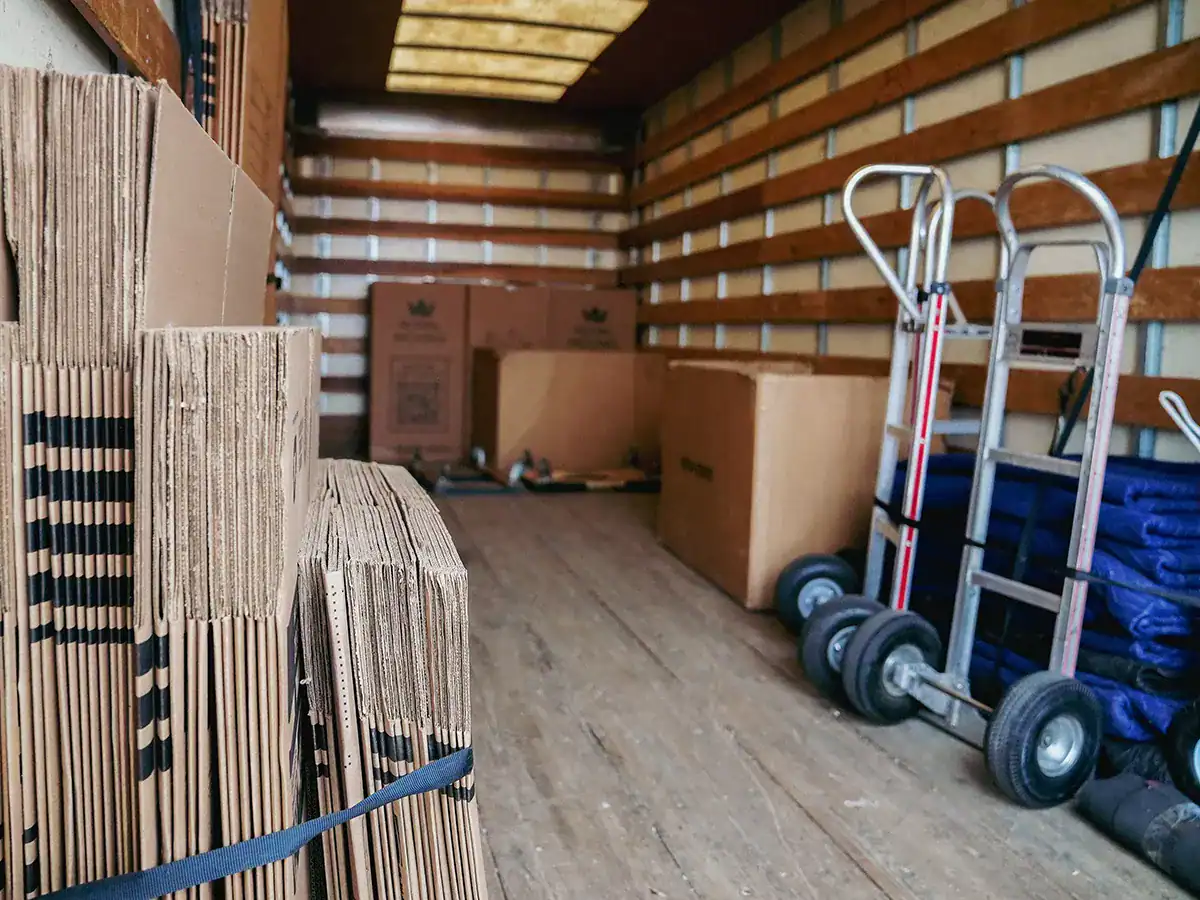
Lakewood is an independent city, so a move here works under the city hall rather than the City of Los Angeles. For larger moves, the city issues temporary no-parking permits that secure curb space at the address. We pull and post each one in advance. Most blocks in the city accommodate a moving truck without difficulty, since the postwar grid was laid out with attached garages, driveways, and frontage roads in mind. The permit keeps the loading point exactly where it is needed, particularly along Lakewood Boulevard, Carson Street, and around Lakewood Center.
The housing itself is the next factor in a Lakewood move. The original 1950s tract homes were small by today’s standards, around 850 to 1,200 square feet on a 5,000-square-foot lot. They came with tight original doorways, narrow hallways, and modest closet space. Most have been expanded over the decades, with added bedrooms, second stories, garage conversions, and remodeled kitchens. The load order on a given address often follows the additions rather than the original floor plan. The lots are small, and the driveways are short. The side-yard access tends to be narrow. We size the truck to the block, plan the carry path, and bring extra padding for the tight interior turns.
The county-line context matters too. Lakewood is hemmed in by Long Beach, Bellflower, and Cerritos. The 605 corridor runs along the eastern edge. A real share of Lakewood moves involves a pickup or delivery in Long Beach or another nearby city. We work out the route across the 605, the 91, the 405, and the 22 to suit the addresses. We handle the permit, the access, and the truck size before move day, so nothing slows the job once the crew arrives.