Getting to Know Bellflower
How Bellflower Sits
Bellflower is its own city in the Gateway Cities of southeast Los Angeles County, about 15 miles southeast of downtown Los Angeles. It is compact and densely built, roughly 6 square miles holding close to 79,000 people, which gives it one of the highest densities in the region. Because it is its own city, Bellflower sets its own rules for truck parking, oversized vehicles, and permits, separate from those of the City of Los Angeles. It is ringed by neighbors on every side: Downey to the north and northwest, Norwalk and Cerritos to the east, Lakewood to the south, Long Beach to the southwest, and Paramount to the west.
The city is densely residential, mostly postwar single-family tracts and low-rise apartments, with shops and restaurants concentrated along Bellflower Boulevard, the commercial spine that has anchored the city since the 1950s. Bellflower is a diverse, family-centered city with larger households than the county average, which is part of what gives its neighborhoods their full, lived-in feel. It still carries reminders of its Dutch farming roots, down to the Dutch grocers that have served the area for generations.
From Belle Fleur Apples to a Postwar City
The land was home to the Tongva people long before the Spanish land-grant era. The town took shape in 1906, when F.E. Woodruff laid it out, and it was first called Somerset. When the post office opened, the name had to change, since another Somerset already existed, and the town took the name Bellflower from the belle fleur apple orchards growing on the ranch where it was platted.
For its first half-century, Bellflower was farm country, first apples and then dairy, worked by Dutch, Japanese, and Portuguese families, supplying milk to much of Southern California. After the war, rising land values and the threat of annexation pushed the farms out, and the houses in, and the population climbed fast as tract neighborhoods filled the old fields. Bellflower incorporated as a city in 1957 to govern itself rather than be absorbed. The dairies are gone now, but the dense, friendly, family-centered city that replaced them still calls itself “The Friendly City” and keeps growing together, as its motto says.
What a Bellflower Move Really Involves
Bellflower runs its own affairs, so the rules that shape a move come from the city, not from Los Angeles. For larger moves, the city provides temporary no-parking permits to hold curb space at the address, which we set up and post in advance. On Bellflower’s full residential blocks, that matters, because open curb is often hard to find, so we reserve it ahead of the day.
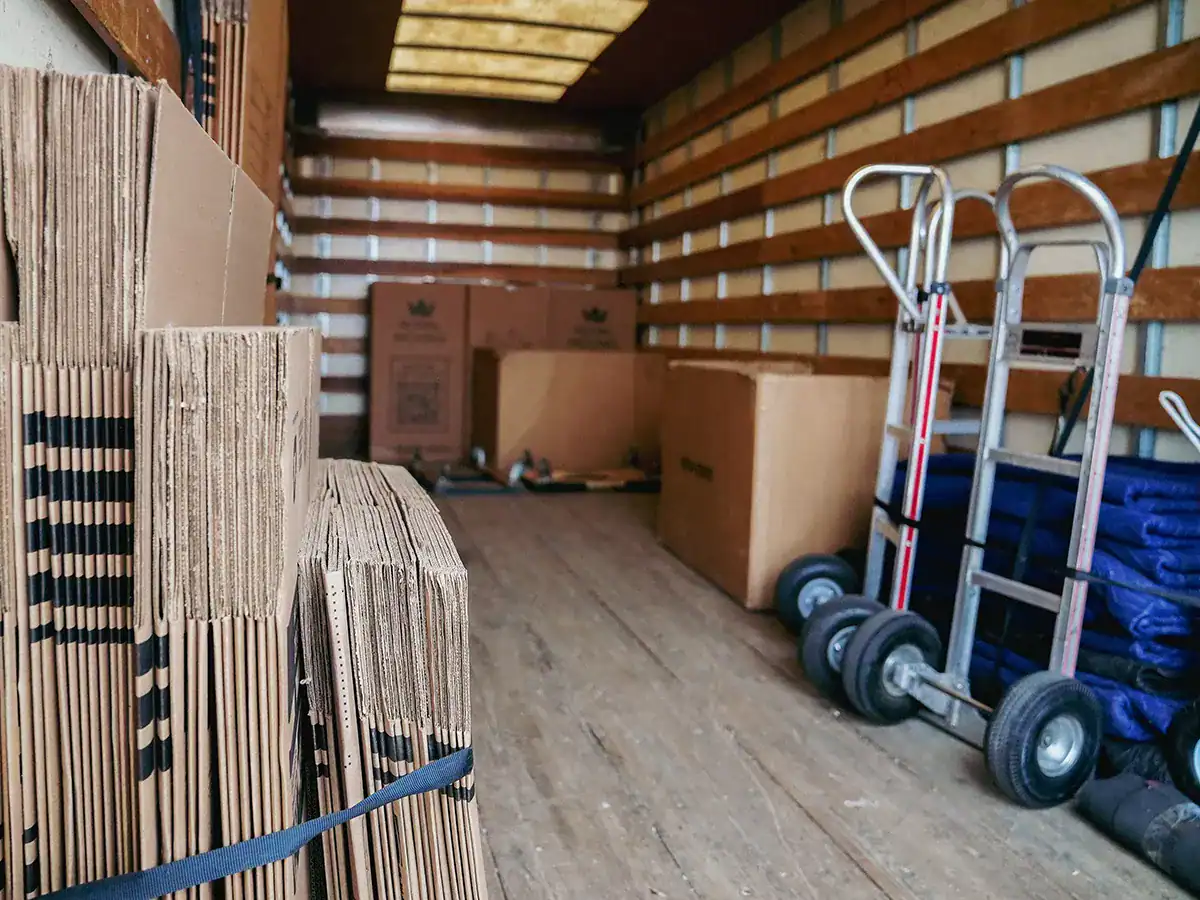
The density and the household size are the local factors that set Bellflower apart. Homes here are often full, with larger and multigenerational families and more to move than the square footage suggests, so we plan crew size and truck space around what is actually in the home rather than guessing from the floor plan. The low-rise apartments frequently have no elevator and no loading area, so stair carries through tight stairwells and narrow doorways are routine, and we bring the padding and protection to do them without marking the building.
Bellflower Boulevard and the other main corridors stay busy, so we plan the route and the timing to work around the traffic. We handle the permits, the curb space, and the truck size before move day, so nothing stalls things once the crew arrives.