Getting to Know Granada Hills
How Granada Hills Sits
Granada Hills is a neighborhood of the City of Los Angeles, not a separate city, in the northern San Fernando Valley. Because it is part of Los Angeles, moves here follow city rules through the Los Angeles Department of Transportation rather than the local city hall. The neighborhood covers about fifteen square miles and holds roughly 54,000 residents, which makes it one of the most spread-out parts of the city. It sits at the foothills of the Santa Susana Mountains. North Hills and Northridge lie to the south, Mission Hills and Sylmar to the east, and Porter Ranch to the west. The Ronald Reagan Freeway, Route 118, crosses its southern end, and Balboa Boulevard, Devonshire Street, and Chatsworth Street are among the main routes.
The neighborhood is overwhelmingly residential and family-oriented, and about eighty percent of its homes are detached single-family houses, a high share for Los Angeles. It is ethnically diverse, with large white, Latino, Asian, and Korean-American populations, and it is known for its strong schools. Granada Hills holds a few well-loved landmarks. The historic deodar cedars along White Oak Avenue, planted in the 1930s and named a city Historic-Cultural Monument, appeared in the bicycle scene of the film E.T. There is also the Balboa Highlands tract of mid-century Eichler homes, and O’Melveny Park, the second-largest park in Los Angeles, with trails into the mountains.
From Sunshine Ranch to a Valley Neighborhood
The land was home to the Tongva people, and in the 1880s, it became part of the holdings of George K. Porter, a pioneer of the north Valley. For years, the land grew beans and wheat. In 1917, an Oklahoma oilman, J.H. Moshier, bought a large stretch at the foot of the hills, built barns and silos, and named it the Sunshine Ranch. He planted more than two thousand acres of citrus. The Valley’s first oil well had already been drilled nearby in 1916.
The ranch was sold for subdivision in the mid-1920s, and the community was founded in 1926 as Granada, a name drawn from the Spanish word for pomegranate. The word Hills was added about fifteen years later as the neighborhood spread toward the mountains. Through the postwar decades, the old orchards filled with tract homes, mid-century architects built distinctive houses like the Balboa Highlands Eichlers, and Granada Hills grew into the spread-out, family-centered neighborhood it is today. Old citrus trees still stand in many backyards as a reminder of the ranch years.
What a Granada Hills Move Really Involves
Granada Hills is part of the City of Los Angeles, so a move here follows city rules, and most of those come down to parking. For larger moves, the Los Angeles Department of Transportation issues temporary no-parking permits that hold curb space at the address, arranged and posted in advance. On the wide single-family streets that is often straightforward. On the busier blocks and the narrower foothill roads, the permit keeps the truck close to the door.
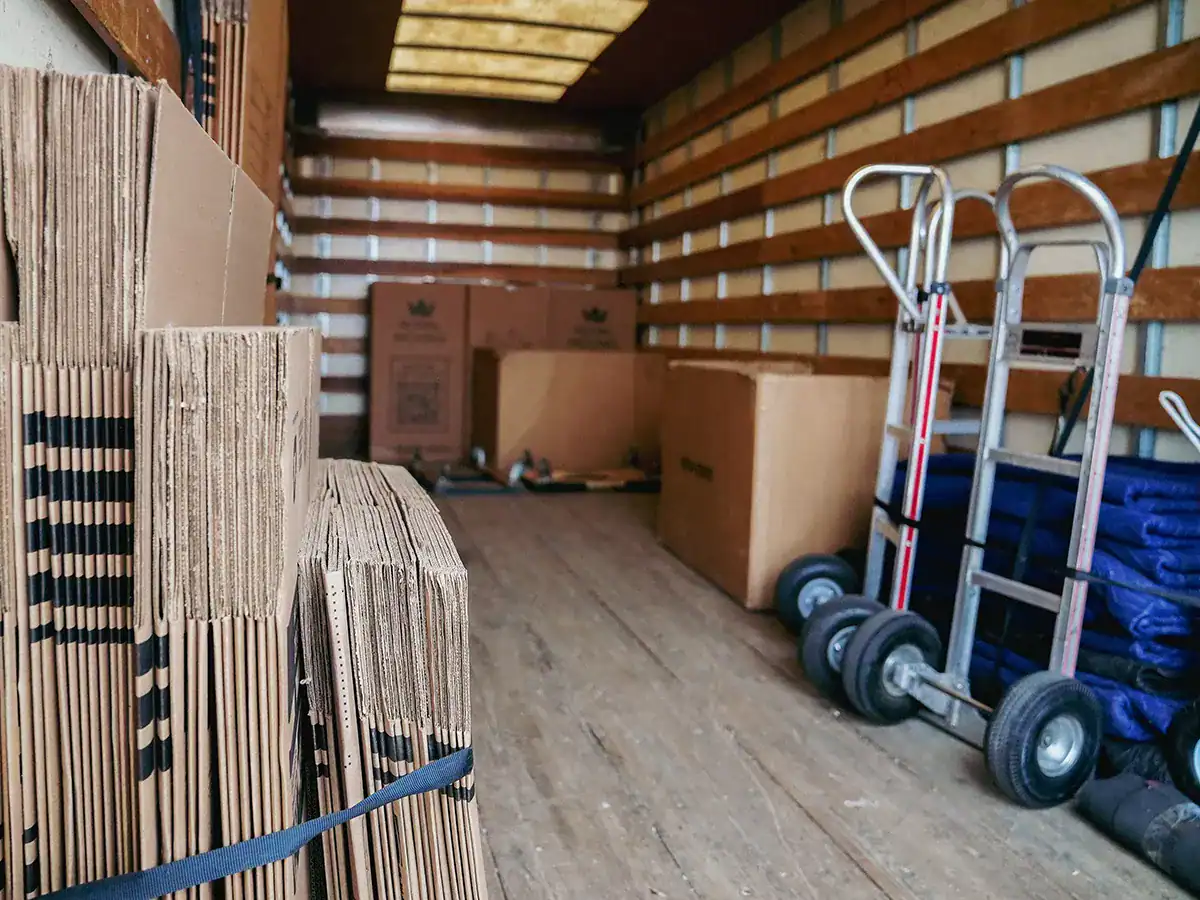
The lots and the terrain are the local factors that shape the work. Most homes are detached houses with driveways and garages, so the job is loading a full home rather than carrying boxes down a stairwell, and we size the crew and truck to the house. In Granada Hills North, the foothill homes can sit behind long or graded driveways, and equestrian-zone properties may have outbuildings and gates to work around, so we plan the approach and the carry in advance. The mid-century homes, including the Eichlers, have original detail worth protecting, and we bring the padding and guards to keep it safe.
The 118 freeway and the main boulevards can be busy at peak hours, so we plan the route and the timing around the traffic. We take care of the permit, the access, and the truck size ahead of move day, so nothing holds up the job once the crew is on site.