Getting to Know Panorama City
How Panorama City Sits
Panorama City is a neighborhood of the City of Los Angeles, in the center of the San Fernando Valley. Because it is part of the city, a move here follows city rules through the Los Angeles Department of Transportation, rather than a separate city hall or the county. The neighborhood covers about 3.8 square miles and holds somewhere around 70,000 residents. It has the highest population density of any community in the Valley.
Van Nuys Boulevard is the main spine of the neighborhood, lined with shops, the Plaza del Valle, and transit. Panorama City sits within easy reach of the 405, 170, 5, and 118 freeways, which is why its original developers called it the Heart of the Valley. Panorama City borders Mission Hills to the north and Arleta to the northeast. Sun Valley lies to the east, Valley Glen to the southeast, Van Nuys to the south, and North Hills to the west.
The housing reflects the original plan and what came after it. The east side holds the neighborhood’s first single-family homes, mostly modest mid-century Ranch houses on curved streets, still among the lowest-cost homes in the Valley. The west side has filled in almost entirely with low-rise apartment buildings. The population is young, with an average age around thirty, dense, and strongly international. More than half of residents were born abroad, the majority from Mexico, and households are often large and multi-generational.
From Panorama Ranch to the Heart of the Valley
The land was part of the wide agricultural Valley that the Tongva people knew for thousands of years before the Spanish missions. By the twentieth century, it was Panorama Ranch, one of the largest dairy and sheep ranches in Southern California. That open ranch land set the stage for one of the most ambitious housing experiments in Los Angeles.
After World War II, veterans were returning, and the Valley was desperate for housing. The developer Fritz Burns teamed up with the industrialist Henry Kaiser, who had built ships during the war and wanted to bring the same mass-production methods to homes. Beginning in 1947 and 1948, they laid out Panorama City as the Valley’s first planned community. The master plan, by the architects Wurdeman and Becket, called for more than four thousand houses, along with land set aside for shops, parks, and schools. The homes were modern, affordable, and built fast. The public lined up to buy them, with thousands touring the model homes every week.
Jobs were part of the plan. A General Motors plant opened on Van Nuys Boulevard in 1947 and grew into one of the area’s largest employers. It built millions of cars and gave thousands of residents work within reach of home. The neighborhood boomed through the 1950s. The General Motors plant closed in 1992 and was replaced by The Plant shopping center, marked today by a mural honoring its history. Through all of it, Panorama City has stayed what it was built to be: a dense, working, family-filled center of the Valley.
What a Panorama City Move Really Involves
Panorama City is part of the City of Los Angeles, so a move here works under LADOT rather than a separate city or the county. For larger moves, LADOT issues temporary no-parking permits that hold curb space at the address, and our office arranges and posts these in advance. The permit matters most on the dense west side, where apartments line the streets and parking is tight. It also matters along the busy stretch of Van Nuys Boulevard.
The two sides of the neighborhood call for different plans. On the east side, the original single-family homes are straightforward, with driveways and garages, and they move much like any Valley house. On the west side, most moves are apartment moves, which bring stair carries, parking permits, and building move-in rules. We handle the coordination with management ahead of time. The curved, planned streets can be easy to get turned around on, so we map the route and the parking before the day.
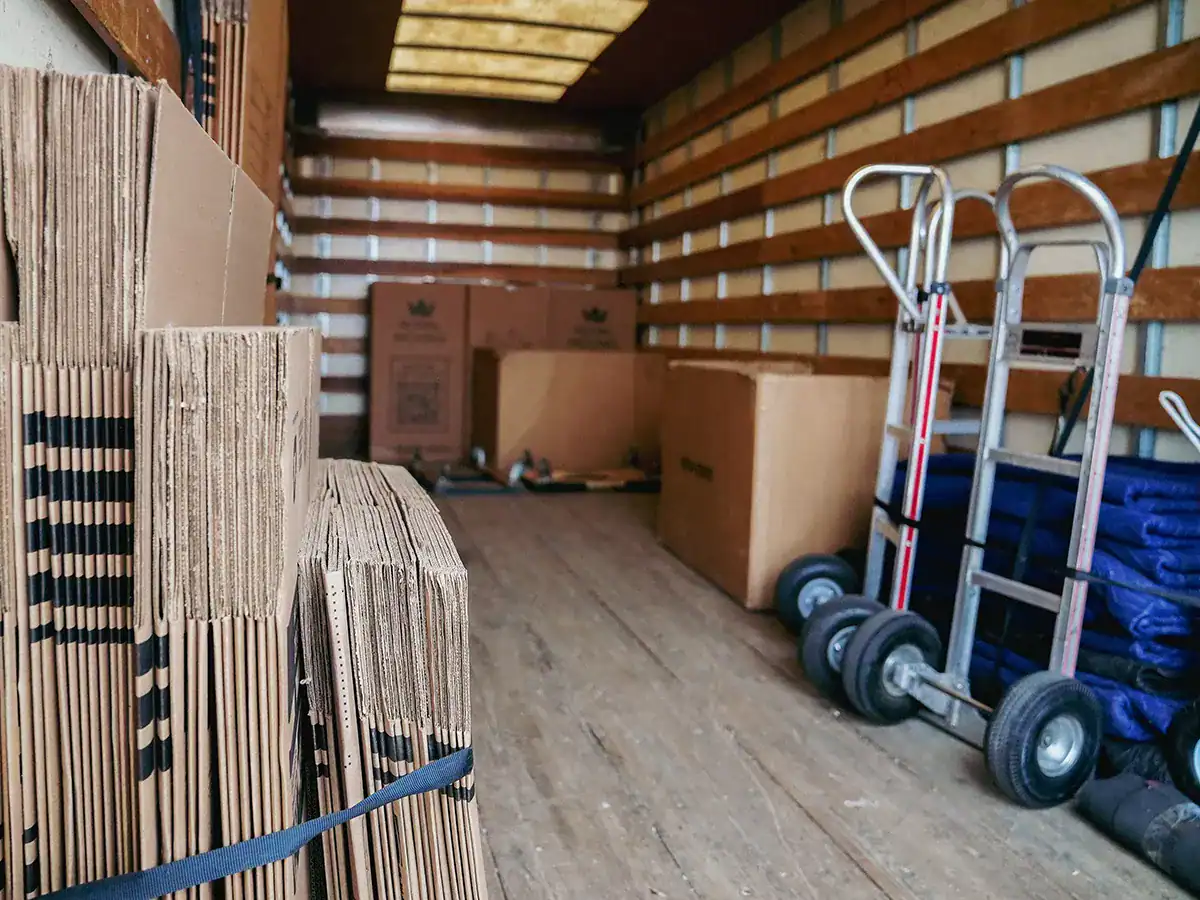
The households are the other factor. Panorama City is densely populated, and many homes hold large, multi-generational families. They carry more furniture and belongings than the floor plan suggests. We size the crew and the truck to the actual load rather than the room count, and bring door and floor protection as a matter of course. The permit, the access, and the parking are settled before move day, so nothing slows the job once the crew arrives.