Getting to Know Canoga Park
How Canoga Park Sits
Canoga Park is a neighborhood of the City of Los Angeles, not a separate city, so its moving truck permits and parking rules run through the city’s transportation department rather than a local authority of its own. It sits in the western San Fernando Valley, about 25 miles northwest of downtown Los Angeles, covering roughly 4 square miles with more than 60,000 residents. Sherman Way runs east to west as its historic main street, and the neighborhood borders Winnetka to the east, Reseda to the northeast, West Hills to the west, Woodland Hills and the Warner Center district to the south, and Chatsworth to the north.
The area is a real mix. There are older single-family homes near the original town grid, postwar tracts, and apartment buildings along the main corridors. A walkable older downtown sits on Sherman Way, with the office towers of Warner Center just to the south. Canoga Park is one of the more ethnically diverse neighborhoods in the Valley, with a large Latino community and households of many backgrounds, and that diversity shows along the shops and restaurants of its main streets.
From Owensmouth to Canoga Park
The land was home to the Tongva and Chumash peoples for thousands of years, then became part of Mission San Fernando, and later wheat farms after the Mexican-American War. The town itself was founded in 1912 and named Owensmouth. Developers pitched it as the mouth of the Owens River water the Los Angeles Aqueduct was about to deliver. Sherman Way was laid out as a grand paved boulevard. Pacific Electric Red Car tracks ran down its center toward Van Nuys and on to Los Angeles.
The young town had no water of its own, so in 1917 it was annexed to the City of Los Angeles, which brought the aqueduct supply. Residents later pushed to drop the Owensmouth name, which pointed to the distant Owens Valley, and in 1931, the community became Canoga Park, with the Post Office adding “Park” to avoid confusion with Canoga, New York. After the war, aerospace arrived, and the Rocketdyne plant on Canoga Avenue built rocket engines for the Apollo program. Today, the old town grid has long since merged into the Valley’s larger street pattern, but Canoga Park keeps its historic downtown and its head start as one of the west Valley’s original communities.
What a Canoga Park Move Really Involves
Because Canoga Park is part of the City of Los Angeles, the truck parking and permits go through the city’s transportation department, which issues the temporary no-parking permits that hold curb space at an address. We set those up ahead of time. Many residential blocks have street parking only, so reserving the curb keeps a large truck from circling for a spot.
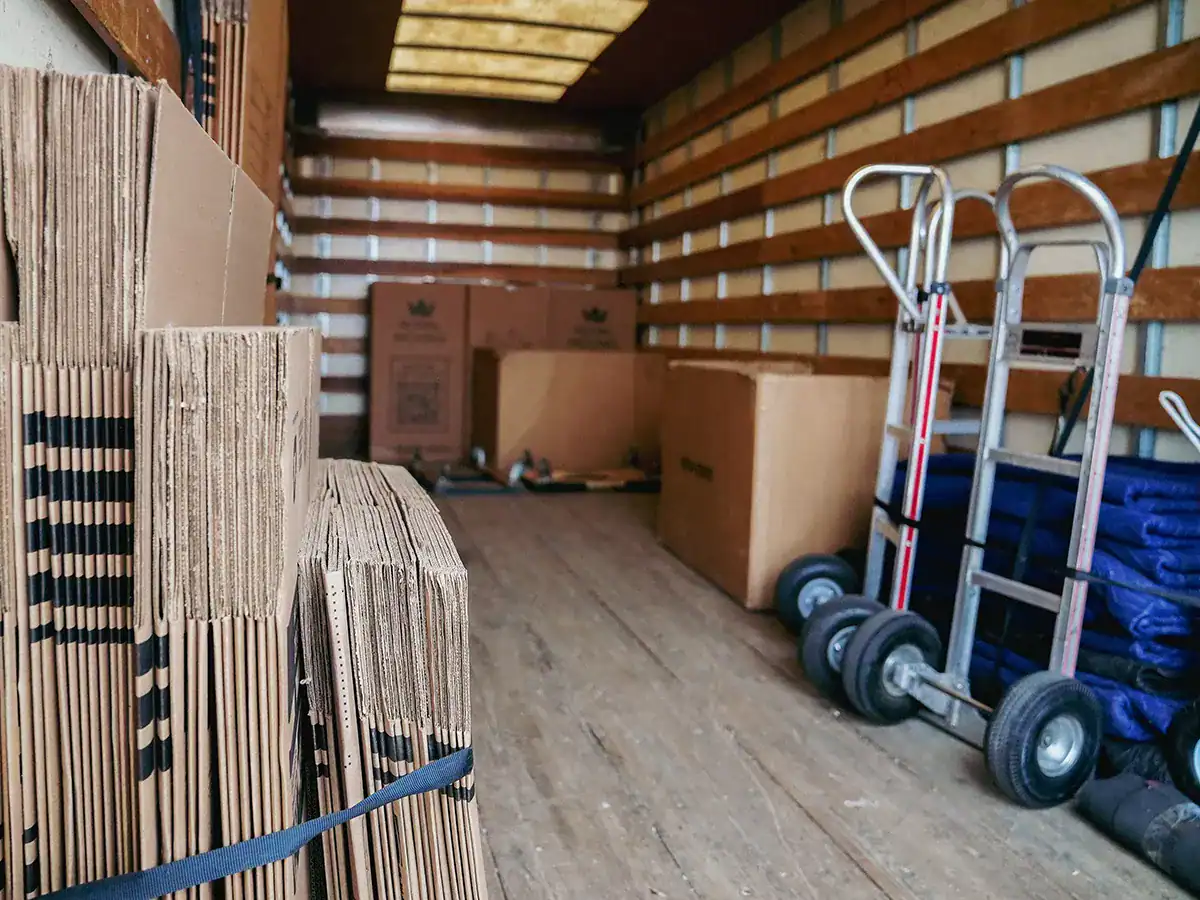
The variety of housing is the local factor that sets a Canoga Park move apart. The older homes near the original Owensmouth grid can have narrow doorways and tight driveways, with no easy place to bring a full-size truck close. So we plan the approach and the carry. The apartment buildings along Sherman Way and the other corridors often have no elevator. That means stair carries through tight stairwells, and we bring the padding and protection to do them cleanly. The newer towers near Warner Center go the other way. They bring reserved freight elevators, loading-dock windows, and certificate-of-insurance rules through building management.
Sherman Way and the other main streets stay busy, so we plan the route and the timing around the traffic. We handle the permits, the building access, and the truck size before move day, so nothing stalls things once the crew arrives.