Getting to Know Gardena
How Gardena Sits
Gardena is a small independent city in the South Bay region of Los Angeles County, about 13 miles south of downtown Los Angeles. It covers just under six square miles and holds around 61,000 residents, which makes it one of the more densely populated cities in the county. Because it is its own city, Gardena sets its own rules on truck parking, oversized vehicles, and permits, separate from the City of Los Angeles. The 110 and 91 freeways run along and through the city, and Western Avenue, Vermont Avenue, and Redondo Beach Boulevard are among the main routes. Gardena borders Torrance to the south and west and Hawthorne to the north and west. The Los Angeles area of Harbor Gateway sits nearby, with Compton and unincorporated county land to the east.
The city is overwhelmingly residential, a dense mix of older single-family homes, postwar tract houses, and apartment buildings, with commercial corridors and light industry along the main roads. Gardena is one of the most diverse cities in the area, long known for one of the largest Japanese-American communities in California, with a strong Korean-American community and many other families besides. The Gardena Willows Wetland Preserve, a rare patch of natural marshland, and the city’s cardroom casinos are among its landmarks.
From Berryland to a South Bay City
The land was home to the Tongva people, and later formed part of Rancho San Pedro, the vast holding of the Dominguez family. The first settlement took shape in 1887, led by the Civil War veteran Spencer Roane Thorpe. The railroad boom of the 1880s put Gardena on the map. The fertile, well-watered ground filled with strawberry fields, earning the area the nickname Berryland, and an annual Strawberry Day Festival. Japanese immigrant farmers became central to that early agricultural economy.
The berry industry faded around World War I, and farmland gradually gave way to homes. In 1930, Gardena incorporated as a city, joining the rural communities of Gardena, Moneta, and Strawberry Park, largely to protect itself from a heavy county tax. From 1936 to 1980, the city held a local monopoly on legal cardrooms, and the taxes they generated funded nearly a third of its budget for decades. Through the twentieth century, the farmland filled with tract housing, the Japanese-American community put down deep roots, and Gardena grew into the dense, diverse residential city it is today.
What a Gardena Move Really Involves
Gardena runs its own affairs, so the rules that shape a move come from the city, not from Los Angeles. For larger moves, the city issues temporary no-parking permits that keep curb space clear at the address, which we set up and post in advance. On Gardena’s dense, full blocks, where driveways are short and curb space is limited, reserving that space keeps a truck close to the door.
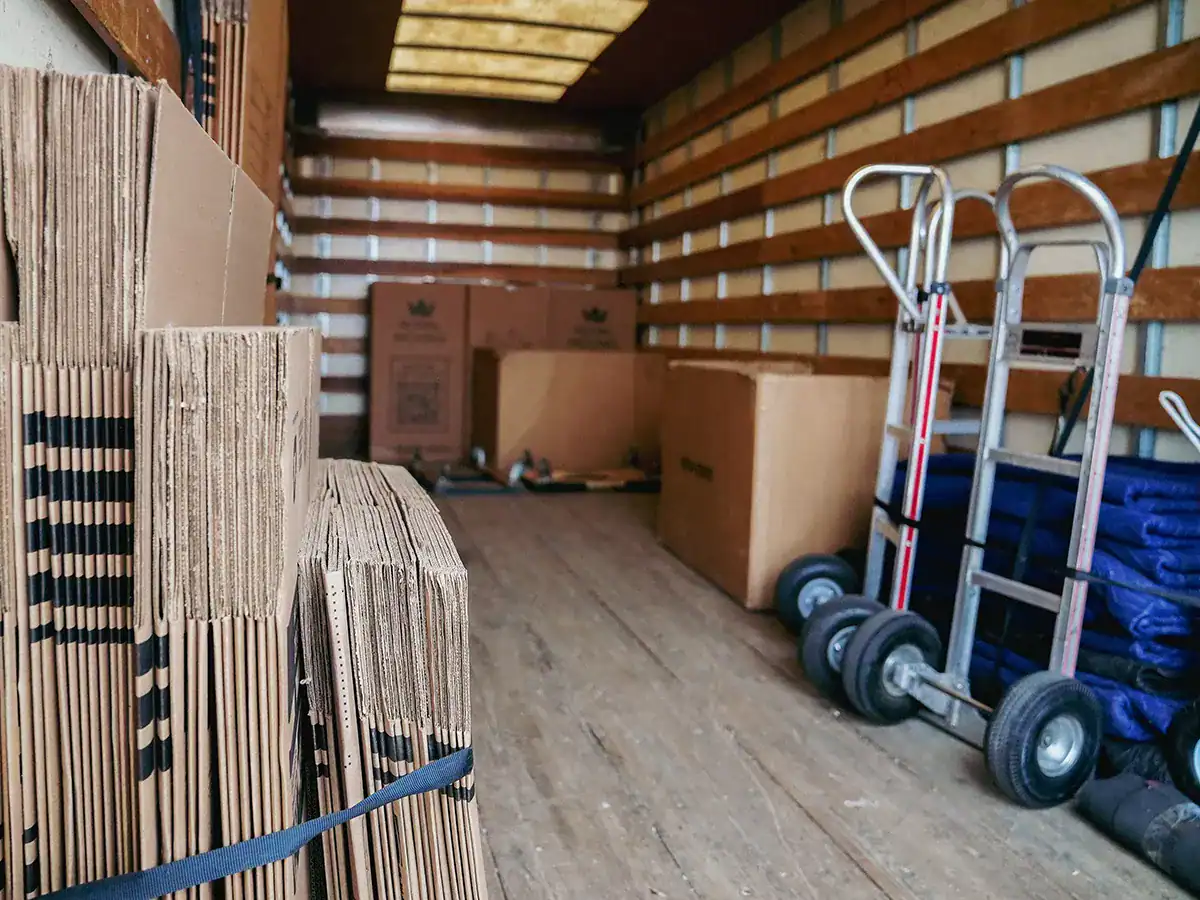
The density is the local factor that sets a Gardena move apart. Most homes here sit on modest lots along narrow streets, so we match the truck to the block and plan where it can park and load. Many of the older homes and postwar houses have narrow doorways and small driveways. The apartment buildings often have no elevator, which means stairs carry through tight stairwells. We bring the wrapping and protection to get through any of them cleanly. The long-held family homes can hold more than they appear to, so we size the crew and truck to the real volume rather than the floor plan alone.
The 110 and 91 freeways and the busy main boulevards can make timing tight, so we plan the route and the hours to work around the congestion. We handle the permit, the access, and the truck size ahead of move day, so nothing stalls the job once the crew is on site.