Getting to Know Hermosa Beach
How Hermosa Beach Sits
Hermosa Beach is one of the smallest cities in Los Angeles County, with just 1.4 square miles of land. It still holds about 19,700 residents, for a density of around 13,800 people per square mile, among the highest in the county. Because it is its own city, Hermosa Beach sets its own rules on truck parking, oversized vehicles, and permits, separate from the City of Los Angeles. Pacific Coast Highway runs through the middle of the city as the main north-south route, with Pier Avenue running east-west toward the ocean. The city sits at the center of the three Beach Cities. Manhattan Beach lies immediately to the north and Redondo Beach immediately to the south. Hawthorne and the unincorporated South Bay flats are inland to the east. LAX is about six miles north.
The city is mostly residential, with a dense mix of single-family houses, beach cottages, condos, townhomes, and small apartment buildings. The downtown around Pier Avenue is a compact, walkable strip of restaurants, bars, and shops, and the two miles of beachfrontage and the Strand draw heavy tourist traffic through the summer. The walk streets are one of the defining features of the lower-numbered blocks. These narrow pedestrian-only walkways run between blocks toward the ocean, and they shape how moves are loaded along that part of the city.
From Rancho Sausal Redondo to a Beach Playground
The land was home to the Tongva people for thousands of years. During the Spanish era, it sat within the 1784 Rancho San Pedro grant, later folded into Rancho Sausal Redondo. In 1900, a 1,500-acre tract was purchased for thirty-five dollars an acre. It was brought into the Hermosa Beach Land and Water Company, which subdivided it the following year. The first official survey was made in 1901 for the boardwalk along the Strand, for Hermosa Avenue, and for Santa Fe Avenue, later renamed Pier Avenue.
The town incorporated on January 14, 1907, becoming the nineteenth city in Los Angeles County. The land company deeded the city two miles of ocean frontage, to be held in perpetuity as a public beach playground free from commerce, a commitment still reflected in the open Strand and beach today. The Santa Fe Railway built a stucco depot in 1926. Through the twentieth century, Hermosa grew from a small beach town into the dense, residential, surfing-and-volleyball city it is now, with its small downtown and its walkable grid intact.
What a Hermosa Beach Move Really Involves
Hermosa Beach is an independent city, so a move here works under the city hall rather than the City of Los Angeles. For larger moves, the city issues temporary no-parking permits that hold curb or alley space at the address, arranged and posted in advance. On Hermosa’s tight streets, parking is already at a premium, and the summer crowds add to it. The reserved space keeps the truck close to the only loading point that works.
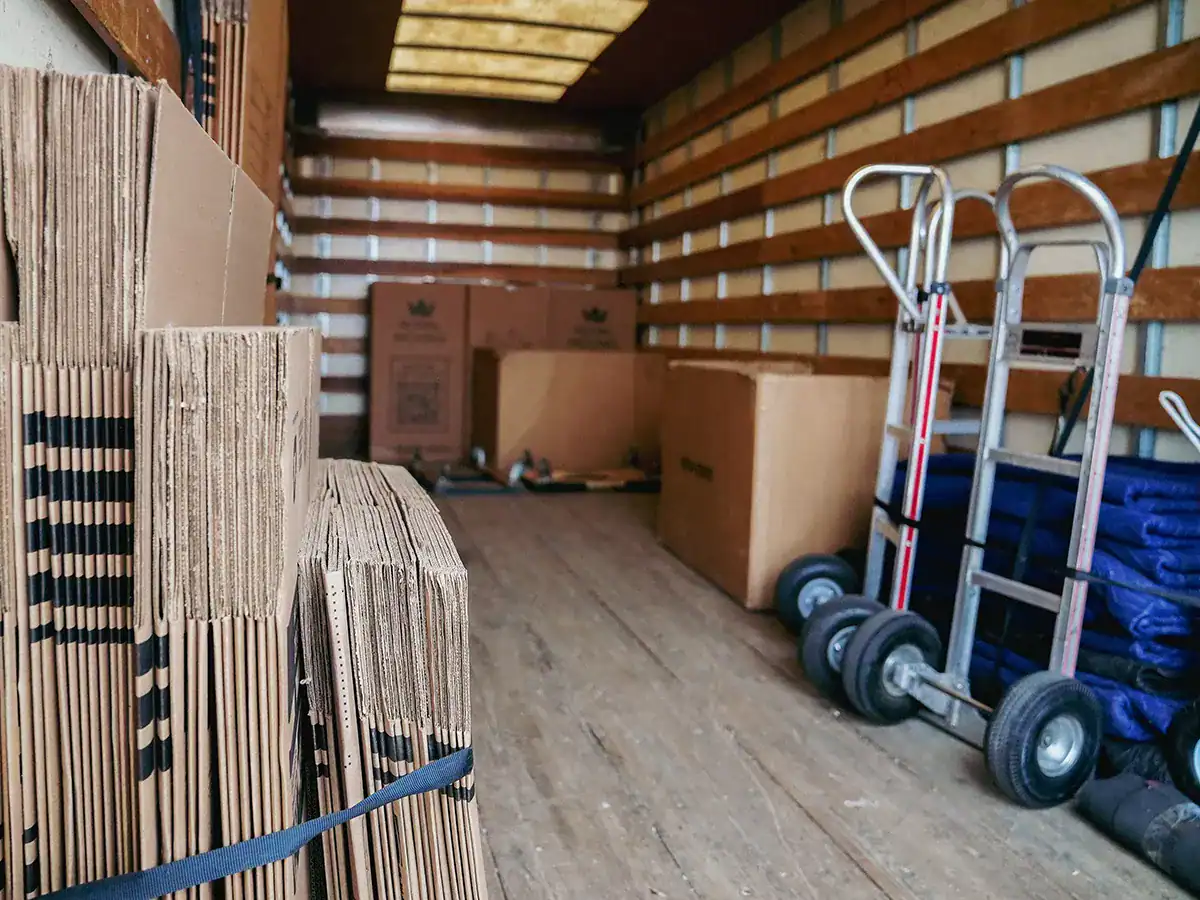
The access is the local factor that sets the work apart. On the walk-street homes, the truck cannot reach the door at all. We stage on the nearest cross-street or in the alley. The crew sets up the carry path, lays floor runners, and walks everything in by hand. The crew has to be sized for that longer carry, and we schedule it for hours that avoid the heaviest foot traffic. Strand-side homes are loaded from the rear alley side. The Strand itself is closed to vehicles. Even on the standard street-facing properties, most lots are loaded from the alley rather than the front. The side and rear access becomes the working side of the move.
Traffic and crowds matter too. Pacific Coast Highway runs heavily at peak hours. The downtown around Pier Avenue fills up on weekends, and summer beach days can bring close to a million visitors a month. We plan the route and the timing around all of that, and pull early or late slots where it helps. We sort out the permit, the access, and the truck size before move day, so nothing holds up the job once the crew arrives.