Getting to Know Venice
How Venice Is Laid Out
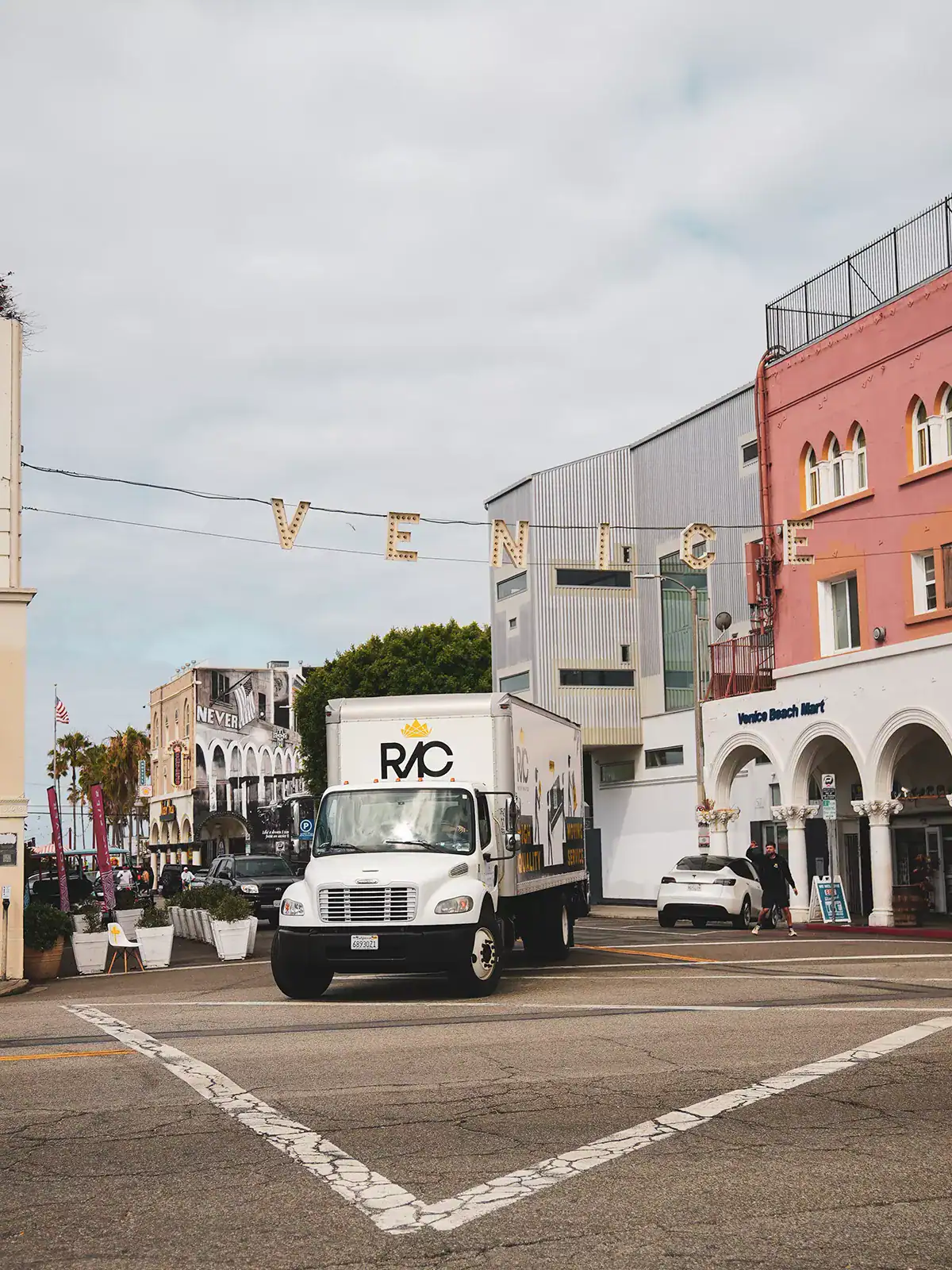
Venice is a neighborhood of the City of Los Angeles, right on the coast, about 14 miles west of downtown. Because it is part of LA, city rules and LADOT permits govern a move here, not a city hall of its own. It covers roughly three square miles, and it is one of the most distinctive places on the Westside, known for its beach, its boardwalk, and its canals.
The neighborhood packs in a lot of different ground. The Venice Canals Historic District, southeast of the boardwalk, is a quiet grid of waterways lined with homes, footbridges, and narrow walkways. The Ocean Front Walk, the two-and-a-half-mile boardwalk, runs along the sand with vendors, performers, and Muscle Beach. Abbot Kinney Boulevard is an upscale shopping and dining strip. The walk streets are narrow pedestrian lanes where homes sit along a path, not a road. Inland, the Oakwood area and the blocks toward Lincoln Boulevard hold more apartments and homes. Santa Monica sits to the north and Marina del Rey to the south.
Abbot Kinney’s Venice of America
The land was home to the Tongva people, and later part of the Mexican Rancho La Ballona. Everything changed when tobacco millionaire Abbot Kinney bought the marshy coastal land and set out to recreate Venice, Italy, by the Pacific. He drained the marsh by digging miles of canals and opened “Venice of America” on July 4, 1905, complete with a pier, a dance hall, a saltwater plunge, and gondolas with real gondoliers poling visitors through the water.
Venice ran as its own independent city for two decades. Los Angeles annexed it in 1926, and soon after, the city paved over most of Kinney’s original canals and turned them into streets. The handful of canals that survive today, south of the old lagoon at Windward Circle, fell into disrepair for years before a full restoration in the early 1990s brought them back. In recent years, Venice added another chapter, as Google and other tech firms moved in and gave the beach town its “Silicon Beach” nickname. The canals, the boardwalk, and the tech offices now share the same few square miles.
What a Venice Move Really Involves
Because Venice is part of the City of Los Angeles, the rules that shape a move come from the city. For larger moves, LADOT issues temporary no-parking permits that hold curb space at the address, and these have to be lined up and posted ahead of time. Near the beach, parking is tight and tightly enforced, so the permit and the parking plan matter more here than almost anywhere.
Access is the real Venice challenge. On the canals and the walk streets, there is no road to the front door. A truck cannot pull up, so the crew parks at the nearest street and carries everything in along the walkway or over a footbridge. That takes more hands and more planning, and we build it into the job from the start. We measure the carry and pick the staging spot before move day.
The rest of Venice has its own needs. Apartments near Abbot Kinney and Lincoln bring stairs, building access windows, and certificate-of-insurance rules. The Silicon Beach offices often hold sensitive gear that needs careful handling. We arrange the permits, the parking, the carry plan, and the right truck before the day, so nothing holds up the move once we arrive.