Getting to Know El Monte
How El Monte Sits
El Monte is an independent city in the San Gabriel Valley, about 12 miles east of downtown Los Angeles, set on the land between the San Gabriel and Rio Hondo rivers. It covers roughly 9.6 square miles and holds more than 109,000 residents, which makes it both one of the larger cities in Los Angeles County and one of the densest ones. Because it is its own city, El Monte sets its own rules on truck parking, oversized vehicles, and permits, separate from the City of Los Angeles. The 10 and 605 freeways meet within the city, and Valley Boulevard runs through its center. All of that makes El Monte a transit hub for the region, anchored by a large bus station that connects the valley to downtown.
The city is mostly residential, a dense mix of single-family neighborhoods and small apartment buildings, much of it built in the decades after World War II, with commercial corridors and light industry along the main roads and the freeways. El Monte is known as a working, family-oriented community with a long agricultural past, a predominantly Latino population, and a notable Asian community. Its nickname, the End of the Santa Fe Trail, and the Santa Fe Trail Historical Park point back to its origins as the oldest settlement in the San Gabriel Valley.
From the End of the Trail to a Valley Hub
The land between the rivers was fertile and well-watered, home to the Tongva people, and Spanish missionaries and soldiers passed through it from the 1770s onward, naming it El Monte for its wooded meadows. In the 1840s and 1850s, it became the western end of the Old Spanish Trail, long called the Santa Fe Trail, and the gold rush brought settlers from Texas, Arkansas, and Missouri who put up adobe homes and a schoolhouse and stayed to farm. A stage station opened in 1849, and the first dwellings followed in the early 1850s.
The Southern Pacific Railroad reached El Monte in 1873 and spurred decades of agriculture, with walnut groves, fruit orchards, dairies, and flower-seed fields spreading across the area. The city was incorporated in 1912. In the 1930s, it became a site for the New Deal’s Subsistence Homestead program, which built single-family ranch homes that the photographer Dorothea Lange documented. The El Monte Berry Strike of 1933 marked an important moment in the region’s labor history. Through the postwar decades, the orchards gave way to tract housing as the population grew, and El Monte became the dense residential city it is today, still anchored at the crossroads it has occupied since trail days.
What an El Monte Move Really Involves
El Monte runs its own affairs, so the rules that shape a move come from the city, not from Los Angeles. For larger moves, the city provides temporary no-parking permits that keep curb space open at the address, which we organize and post in advance. On El Monte’s full residential blocks, where driveways are short and curb space is limited, reserving that space keeps a truck close to the door.
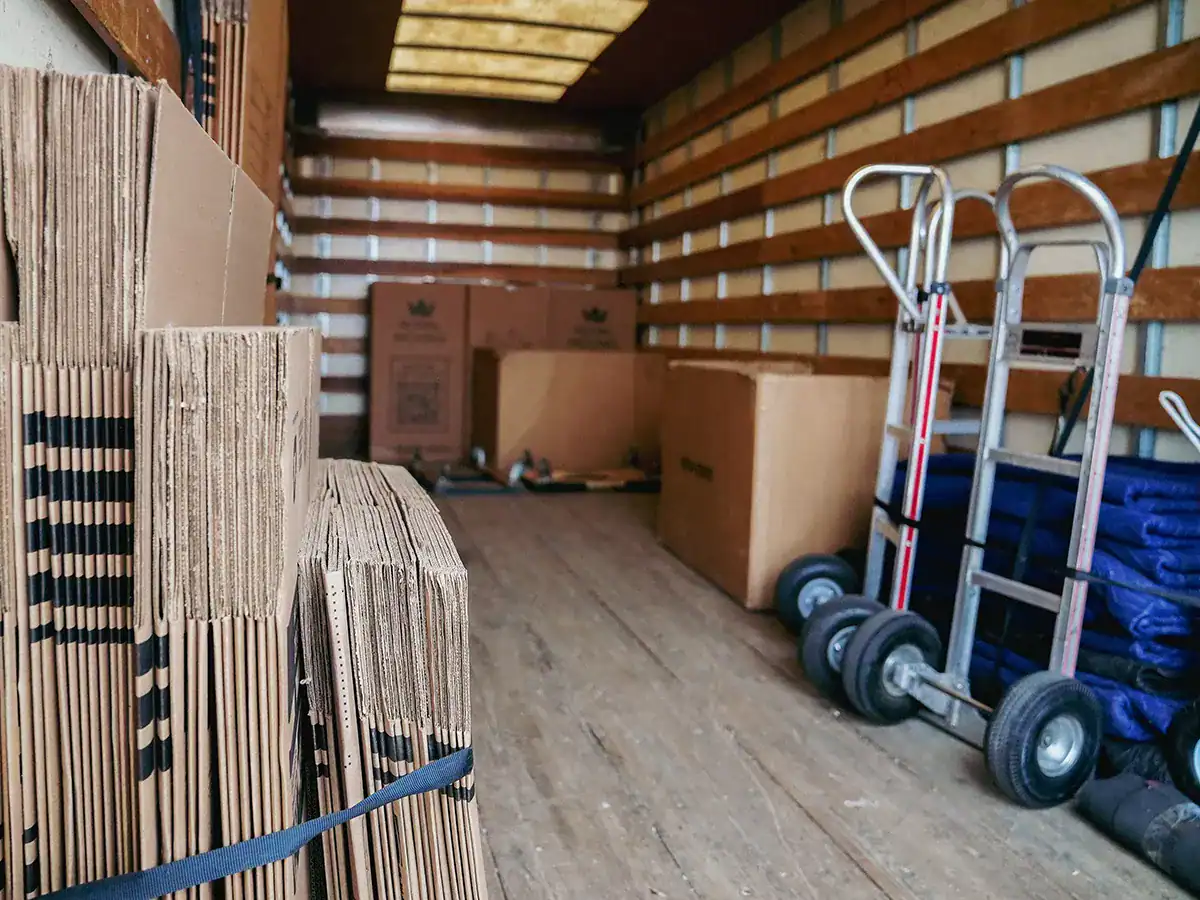
The density and the grid are the local factors that set an El Monte move apart. Most homes here sit on modest lots along tight streets, so we size the truck to the block and plan where it can park and load. Many of the postwar tract homes and older houses have narrow doorways and small driveways, and the apartment buildings often have no elevator, which means stair carries. We bring the padding and protection to move through any of them cleanly.
El Monte’s position at the meeting of the 10 and 605 freeways makes it convenient but busy, and Valley Boulevard and the streets near the transit center carry heavy traffic. We plan the route and the timing around the congestion, and we arrange the permit, the access, and the right-size truck before the day, so nothing holds up the move once we arrive.