Getting to Know Temple City
How Temple City Sits
Temple City is a city in the western San Gabriel Valley, about thirteen miles east of downtown Los Angeles. It covers roughly four square miles and had about 35,700 people at the 2020 census. It is a compact, mostly residential city, and a large majority of residents own their homes. It borders Arcadia to the north, El Monte to the south and east, San Gabriel to the west, and Rosemead to the southwest, with the San Gabriel Mountains rising to the north. A large share of residents are of Asian descent, part of the wider East Asian community across the valley.
The city is known for two things above all: its homes and its camellias. Most of the city is single-family residential on quiet, tree-lined streets, with condos and townhomes near the main roads. The slogan, Home of the Camellias, dates to 1944, and the Camellia Festival each February is the city’s signature event, a youth-run parade and carnival in Temple City Park that draws around twenty thousand visitors. The commercial corridors run along Las Tunas Drive and Rosemead Boulevard, which meet at the Soaring Teapot fountain, a local landmark.
Temple City is also known as one of the safer cities in California, with a strong family character and well-regarded schools, which is a major reason families settle here. The result is a quiet, compact, family-centered city that keeps a small-town feel inside the dense San Gabriel Valley.
From Walter Temple’s Town to the Home of the Camellias
The land was home to the Tongva people and later part of the Mexican Rancho Santa Anita, the vast holding that became Lucky Baldwin’s ranch. In 1923, Walter P. Temple, a member of one of the region’s pioneer families, bought about 300 acres of the old rancho four miles east of San Gabriel and laid out a town where people of modest means could own a home.
Temple planned the community with care. He set aside a park facing Las Tunas Drive, named the streets after family and friends, including Workman, Kauffman, Rowland, and Agnes, and pushed for paved streets and electricity. He petitioned the Pacific Electric Railway to extend its Los Angeles to Alhambra line to a depot at the park, and that rail connection drove the town’s early growth.
The town was named Temple at first, then renamed Temple City in 1926 after the postmaster found mail going by mistake to Tempe, Arizona. It stayed a community in name only through the prewar years. The postwar housing boom filled it in, and the voters approved incorporation as a city on May 25, 1960. The quiet town Walter Temple laid out grew into the settled residential city it is today.
What a Temple City Move Really Involves
Temple City is small and mostly residential, so most moves here turn on the home and the street rather than distance. We start by working out where the truck parks and how each item reaches it. On the residential blocks that means modest lots, regular driveways, and a manageable carry to the door. Near the corridors it means condos and townhomes with shared entrances and stairs. On Las Tunas and Rosemead it means loading zones that can fill during business hours. We settle the parking and the access ahead of the day.
The home comes next. A single-family house has a regular driveway and a straightforward path, though the lot can be compact. A condo or townhome has a shared entrance and a stairwell, with an elevator to reserve if there is one. We check the lot, the stairs or elevator, and the carry distance ahead of time, and bring the protection and the crew size to match.
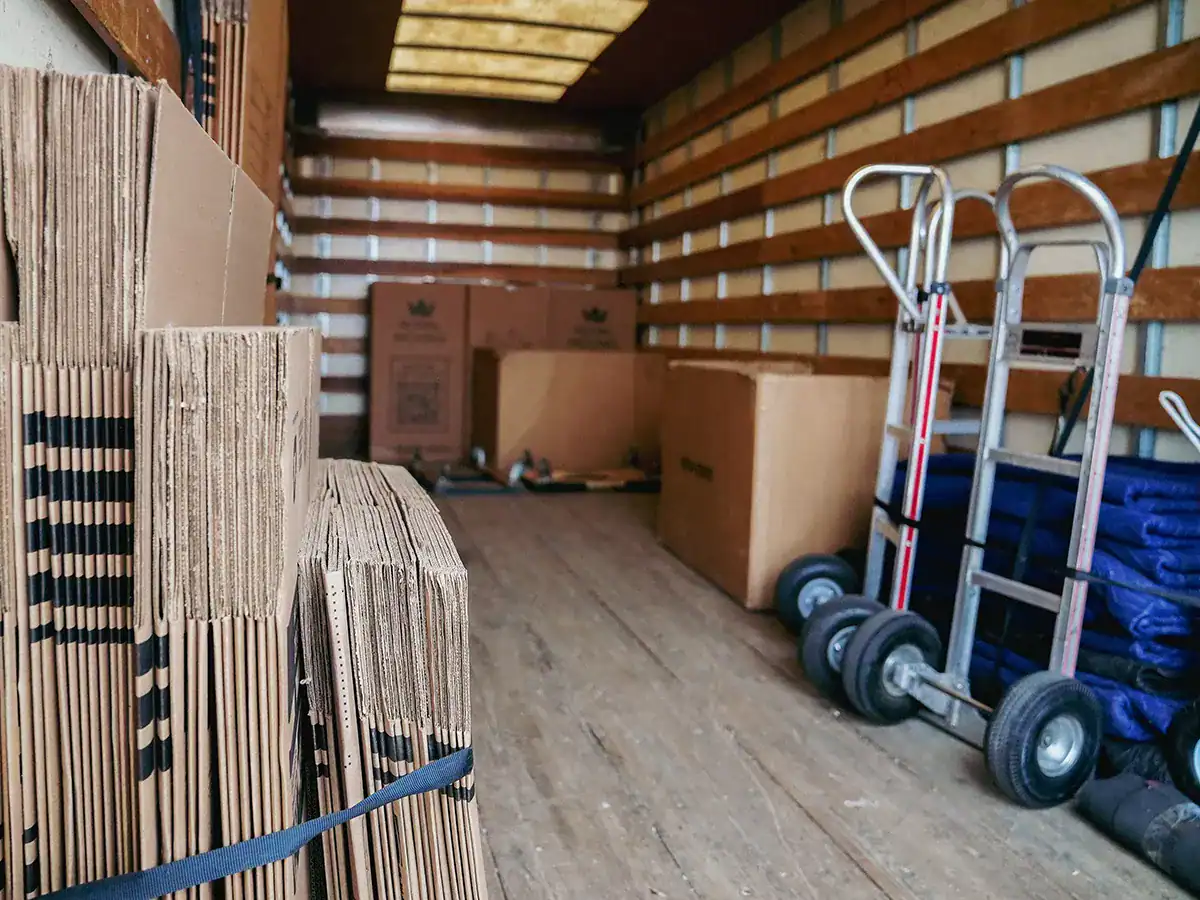
The third piece is what is going on the truck. A single-family home, a townhome near Las Tunas, a shop on Rosemead, and a full family household each call for a different plan. A Temple City home often holds a full multigenerational household, so the load can run heavier than the lot would suggest. Door, railing, and floor protection are standard, and the handling for fragile and valuable pieces is planned ahead. With the parking, the home, and the handling all set beforehand, the crew runs without pause once it is on site.