Getting to Know West Covina
How West Covina Sits
West Covina is an independent city in the eastern San Gabriel Valley, about nineteen miles east of downtown Los Angeles. It is large and suburban, covering about sixteen square miles with more than 100,000 residents. That makes it one of the more populous cities in the county. Because West Covina is its own city, it sets its own rules on truck access, oversized vehicles, and permits. It incorporated in 1923 and runs on a council-manager government, with its city hall on West Covina Parkway.
The San Bernardino Freeway, the 10, runs through the city and ties it to downtown Los Angeles and the Inland Empire. The 605 is close by to the west and the 60 along the south. Azusa Avenue, Vincent Avenue, Sunset Avenue, and Cameron Avenue are among the main surface routes. West Covina borders Covina to the northeast and Baldwin Park and Irwindale to the northwest. La Puente and Valinda lie to the southwest, the City of Industry to the south, and Walnut to the southeast.
The housing is overwhelmingly single-family, the legacy of the postwar boom that built most of the city in a hurry. Moderately priced tract homes fill the flatter north, and hillside homes sit in the south. There are apartments and condominiums near the commercial center as well. The population is large and diverse, with significant Hispanic and Asian communities. The households often run large. The Plaza West Covina anchors the city’s commercial core, and the historic Hurst Ranch preserves a piece of its agricultural past.
From Walnut Groves to the Fastest-Growing City in America
The land sat within the territory of the San Gabriel Mission, founded in 1771. In 1845 the Mexican governor sold much of what is now West Covina to John Rowland and William Workman, the owners of Rancho La Puente. Through the late nineteenth century and into the twentieth, the area grew citrus and walnuts. The name Covina is said to combine cove and vine, a nod to the early vineyards. The first city roads, including Cameron, Merced, Orange, and Vine, were laid out in 1908.
The city was born from a dispute over a sewage farm. In the early 1920s, the neighboring city of Covina planned to put a sewage disposal site on land that the area’s residents wanted to protect. Rather than let that happen, the 507 residents banded together to take local control. West Covina incorporated as an independent city on February 3, 1923, more to block the sewage facility than out of any grand civic ambition. Walnut and orange groves kept flourishing for decades, and the population was still under 800 in 1930.
Then came the boom. After World War II, the groves gave way to tract housing at remarkable speed. Between 1950 and 1960 West Covina was the fastest-growing city in the United States, its population rising a thousand percent from under 5,000 to more than 50,000. Growth stayed steady through the following decades, and the Fashion Plaza shopping mall opened and grew into the commercial heart of the area. West Covina became one of the major residential and retail centers of the San Gabriel Valley. That role earned it the nickname of the headquarters city of the Valley.
What a West Covina Move Really Involves
West Covina is an independent city, so a move here works under city hall rather than the county or the City of Los Angeles. For a move large enough to call for it, the city grants a temporary no-parking permit that holds curb space at the address. Our team submits the application and sets out the signs in advance. Most West Covina blocks take a moving truck without much trouble, since the postwar tracts were laid out with driveways and garages in mind, but the permit keeps the loading point exactly where it is needed.
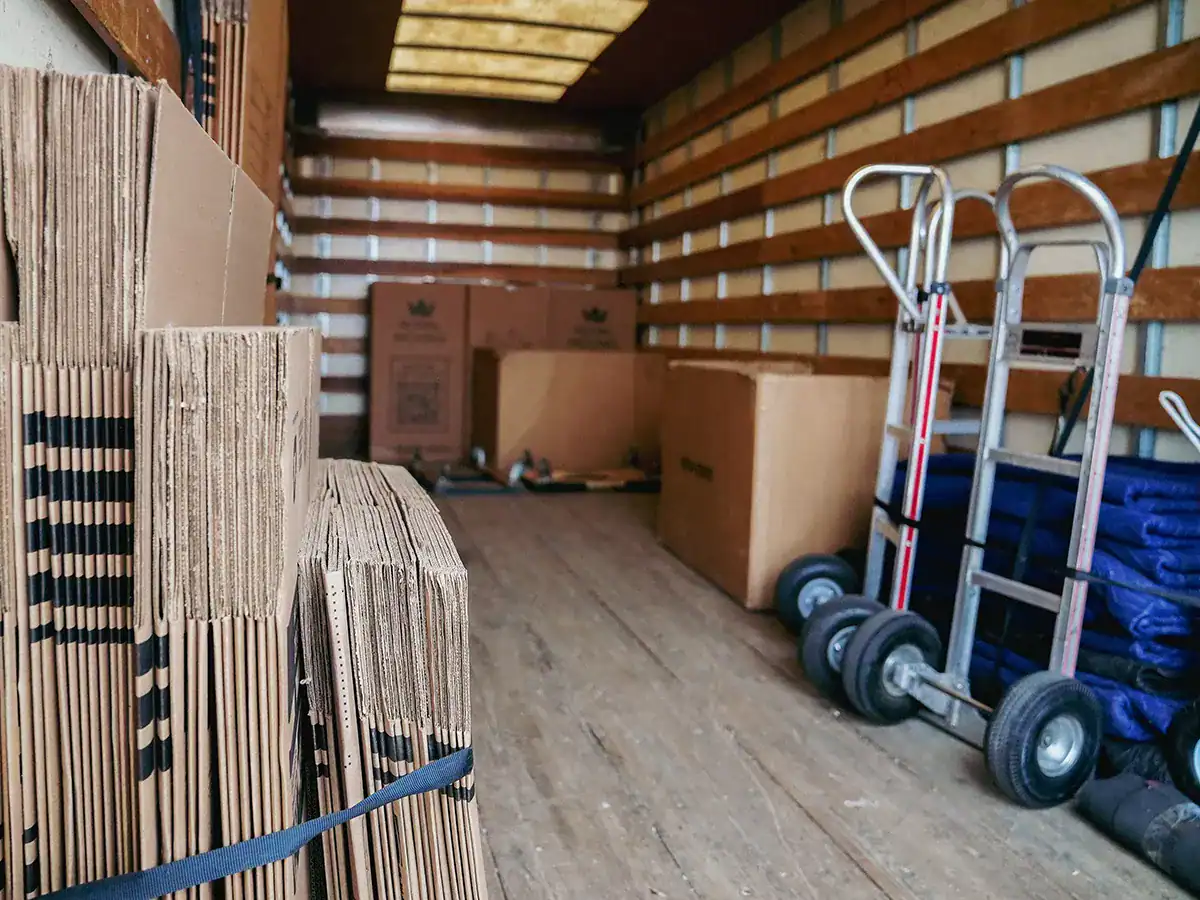
The housing sets the rhythm of the work. Most of West Covina is postwar single-family tract homes, many of them added onto over the years. A home that looks modest from the curb can hold the belongings of a large or multi-generational family. We match the crew and the truck to the actual load rather than the square footage. The packing order tends to track the additions rather than the original layout. The original homes often have tight rooms and narrow doorways. We bring door and floor protection as a matter of course.
The terrain changes in the southern part of the city. The hillside neighborhoods near the 60 climb and curve, with sloped driveways and stepped approaches. We check the grade and the access there before move day. The freeway routing, by contrast, usually works in your favor. With the 10 running through the city and the 605 and 60 close by, a West Covina move to or from anywhere across the Valley or the Inland Empire is straightforward to route. The permit, the access, and the truck size are all handled before move day, so nothing stalls the job once the crew arrives.