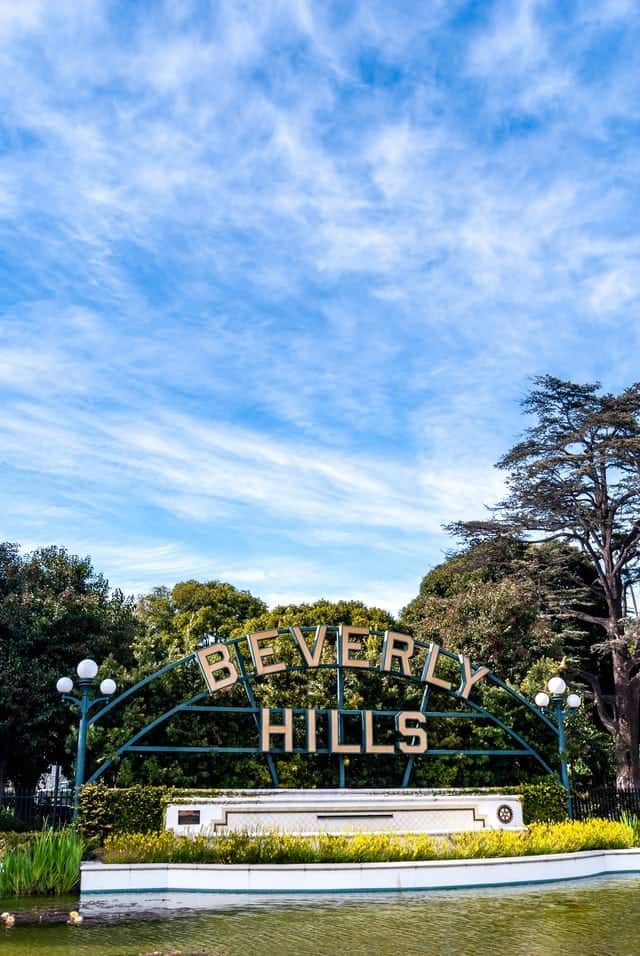
Beverly Hills – More Than an Address
Beverly Hills by the Numbers
Beverly Hills is an independent city of about 5.7 square miles completely surrounded by the city of Los Angeles. It has its own city government, its own police and fire departments, its own school district, and its own building and permitting codes that are separate from Los Angeles city rules. That independence matters for moving logistics because Beverly Hills sets its own rules about truck parking, move-in hours in residential buildings, and permit requirements for large vehicles on certain streets.
The city is divided roughly along Santa Monica Boulevard. South of Santa Monica you have the flats – a mostly flat residential grid of wide streets, luxury condominiums, and single-family homes, plus the commercial heart of the city along Wilshire Boulevard and Rodeo Drive. North of Santa Monica the terrain rises toward the Santa Monica Mountains, and the residential streets become narrower, more winding, and in many cases private or gated.
Beverly Hills has a resident population of around 32,000 people, which is small for a city of this profile, but the daytime population swells dramatically because of the commercial activity along Wilshire, Rodeo Drive, and Little Santa Monica Boulevard. Median home values rank among the highest in California. The city has one of the highest concentrations of luxury condominiums per square mile in the country, concentrated along the Wilshire corridor between Beverly Hills proper and Century City.
The history of the city
The land that became Beverly Hills was part of the Rancho Rodeo de las Aguas land grant during the Spanish and Mexican periods. It passed through several owners in the 19th century and was used primarily for agriculture – lima beans, to be specific. A group of investors led by Burton Green acquired the land in the early 1900s with the intention of finding oil. When the oil search failed, they pivoted to residential development and laid out the city’s original street grid.
Beverly Hills incorporated as a city in 1914, with a population of just 550 people. It might have remained small if Mary Pickford and Douglas Fairbanks had not moved into their estate, Pickfair, in 1920 – a decision that sparked a wave of Hollywood celebrity migration to the area that lasted for decades and permanently defined Beverly Hills’ identity. The Beverly Hills Hotel, originally built in 1912 to attract buyers to the new development, became a landmark in its own right and remains one of the most recognized hotels in the world.
The city resisted annexation by Los Angeles throughout its history, maintaining its independence even as Los Angeles expanded around it. That independence is a source of civic pride and explains why Beverly Hills operates its own municipal services, including the Beverly Hills Police Department, which is distinct from LAPD.
What Hiring a Beverly Hills Moving Company Involves
Beverly Hills has specific municipal rules that affect moving logistics. Large moving trucks on certain residential streets above Sunset require advance notice and, in some cases, permits from the city. High-rise residential buildings on Wilshire require movers to file a Certificate of Insurance with the building before access is granted, and most buildings have designated move-in windows and elevator reservation requirements. The Beverly Hills Police Department is active and responsive, and moving trucks parked in violation of street parking rules will be ticketed quickly. We handle all of this coordination before moving day so nothing delays the job once we arrive.
A good Beverly Hills moving company plans for the city rules, not just the drive. We confirm building move-in windows, file COIs with high-rise management, reserve elevators, and pull street permits for large trucks where the city requires them. For office and commercial jobs, we add after-hours scheduling so business is not interrupted. All of it is handled before move day.