


Vancouver Movers
Let Royal Moving & Storage in Vancouver take care of your relocation from top to bottom!
AS REVIEWED ON



Get your FREE quote

Let Royal Moving & Storage in Vancouver take care of your relocation from top to bottom!
AS REVIEWED ON
Get your FREE quote
Vancouver, Washington sits directly across the Columbia River from Portland, connected by two interstate bridges and separated by a state line. For the people who live here, that position is often the whole point. Washington has no state income tax, and Vancouver gives its residents access to Portland employment, Portland culture, and Portland salaries while keeping their earnings on the Washington side of the ledger. That calculation has driven one of the fastest population growths of any city in the Pacific Northwest, and it shows in the housing stock: new subdivisions spreading north toward Salmon Creek and Hazel Dell, high-density development rising along the Columbia waterfront, and established neighborhoods near the historic downtown that have been filling with buyers priced out of closer-in Portland.
Moving into or out of Vancouver is a cross-state job, even when the distance is short. The crew needs to be ready for I-5 and I-205 bridge traffic, for the regulatory and address-change differences that come with crossing from Oregon to Washington, and for a city whose housing runs from 1890s craftsman homes near Esther Short Park to brand-new townhomes off SR-14 and everything in between. Royal Moving & Storage works all of Vancouver and the Clark County metro, and our Portland market crews make the river crossing a routine part of the job.
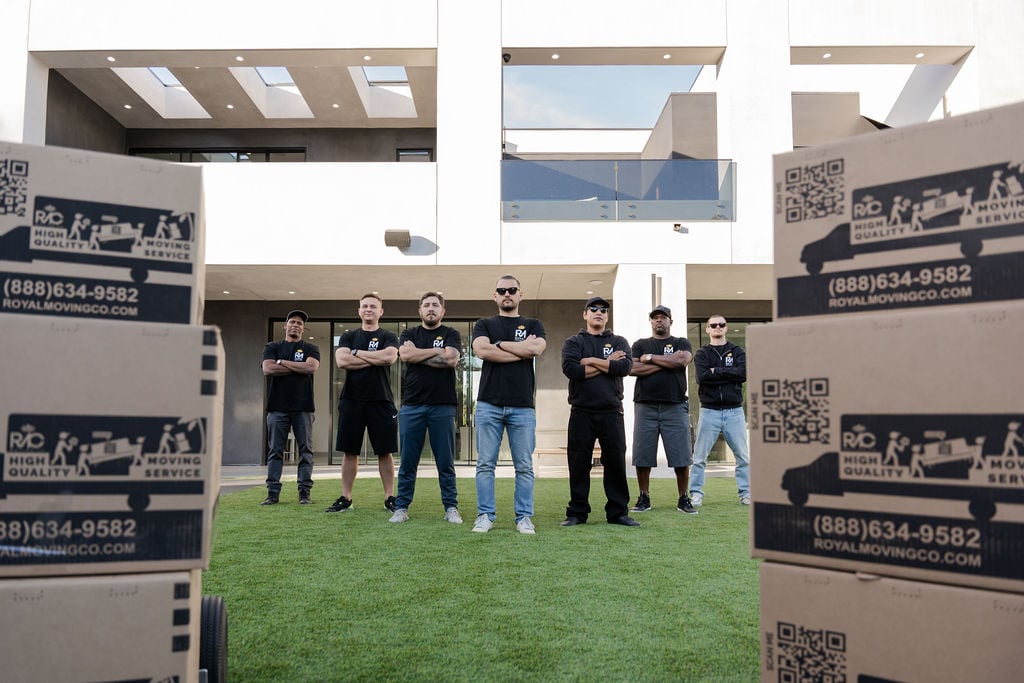


A local move in Vancouver might stay within the city or cross the Columbia into Portland. Either way, bridge traffic is a real planning variable. The I-5 bridge slows significantly during commute windows and on Friday afternoons, and the I-205 crossing at Glenn Jackson adds distance but often moves faster. We plan the routing and schedule around bridge patterns so the move does not lose hours to congestion that could have been avoided. All local moves are priced at a flat rate agreed before we start.

Vancouver housing spans more than a century of construction. The oldest homes cluster around the historic downtown and the established eastside neighborhoods, where craftsman bungalows and mid-century houses sit on tree-lined streets with the access characteristics of their era. The newer developments in Hazel Dell, Salmon Creek, Felida, and Fisher’s Landing are modern in every sense: wide streets, driveways, garages, and homes built for the way people move today. The high-density buildings near the waterfront and downtown core have the same requirements as newer Portland apartments: freight elevator scheduling, certificates of insurance, and building-management coordination. We assess the specific property before moving day and plan around what it requires.

Vancouver has a significant and growing commercial base independent of Portland. PeaceHealth is one of the largest employers in Clark County. SEH America operates a major semiconductor wafer plant. Nautilus, Banfield Pet Hospital, and a cluster of regional headquarters and professional offices make up the broader business district along SR-14 and in the east side commercial areas. When a Vancouver business relocates, we work around operating schedules, coordinate building access, and move equipment and workstations so the disruption is as short as possible.

Vancouver draws people from across the country for employment and quality of life, and some of them eventually move on. When the destination is out of state, we handle the full move with dedicated transport, a complete inventory, a fixed price, and a confirmed delivery window. We do not broker Vancouver long-distance moves to third parties.

From sectionals and antiques to pianos and high-value specialty items, our Vancouver crews wrap, pad, and secure every piece for safe transport. Premium moving pads, stretch wrap, floor runners, and door and wall protection are standard on every job. Older homes in the downtown-adjacent neighborhoods often have original woodwork and tight stairwells that call for extra care. We plan for it.

Vancouver moves frequently involve a timing gap. A home that sells before the next one closes. A relocation where the start date falls before the housing is ready. A move staged across the state line in two phases. Royal Moving & Storage picks up from your Vancouver address, holds your belongings in a secure storage facility, and delivers them when you are ready.

Cross-river moves have real variables: bridge routing, building access on either side, and inventory that may need to be staged in two locations. None of that should make your final number unpredictable. We give you a flat rate before the move starts and hold to it.
You work with one person from the first call through delivery. They know your addresses on both sides of the river, your access situation, your schedule, and your inventory. No call center, no starting over with a new person each time you call.
Check Google, Yelp, or the BBB. The same pattern runs through every review: the crew showed up on time, handled the belongings carefully, and the final cost matched the quote.
Oregon Motor Carrier Certificate #280015. Full cargo and liability coverage on every job, including cross-state moves between Oregon and Washington. If your building or employer’s relocation coordinator requires a certificate of insurance before the move begins, we have it ready.


Vancouver is the county seat of Clark County and the fourth-largest city in Washington state, with a population of more than 190,000 people covering roughly 46 square miles on the north bank of the Columbia River, directly across from Portland. The Vancouver-Portland metro is a single functional economy split between two states, and Clark County is consistently one of the fastest-growing counties in Washington as a result.
The city organizes itself into several distinct zones. The historic core around Esther Short Park and the Fort Vancouver National Historic Site anchors the southwest corner of the city. The Columbia waterfront has seen significant new development, with mixed-use buildings and apartment towers rising on land that was industrial for most of the 20th century. Moving north, established residential neighborhoods fill the middle of the city before giving way to the newer subdivisions of Hazel Dell, Salmon Creek, and Felida that have absorbed most of the population growth of the last two decades. Fisher’s Landing, in the southeast near the I-205 corridor, is one of the most active residential and commercial areas in the region.
Clark County’s position matters for anyone moving across the state line. Washington’s tax structure (no state income tax, but a sales tax) is the inverse of Oregon’s, and many households who commute to Portland choose to live in Vancouver specifically for the income tax advantage. That pattern has made the I-5 and I-205 bridges among the busiest commute crossings in the Pacific Northwest.
The lower Columbia River has been home to Indigenous peoples, including the Chinookan and Sahaptin-speaking communities, for thousands of years. The area that became Vancouver was a well-established point of exchange long before European contact. The Hudson’s Bay Company established Fort Vancouver on the north bank of the Columbia in 1825, later rebuilding it in 1829 at a position closer to the river, and it became the commercial and supply hub for the entire Pacific Northwest under the direction of Dr. John McLoughlin.
The fort’s role as the center of the fur trade, agricultural production, and supply for the region made it one of the most significant settlements on the Pacific coast during the 1830s and 1840s. The Oregon Trail emigration brought thousands of Americans to the Columbia, and many of them passed through or stopped at Fort Vancouver before continuing to the Willamette Valley. The United States Army established a military post adjacent to the fort in 1849, and the U.S. Army Barracks at Vancouver became one of the oldest continuously operated military installations in the Pacific Northwest.
Pearson Field, located on the grounds of the historic fort, has operated as an airfield since 1905, making it one of the oldest operating airfields in the United States. It was the landing site for the first transpolar flight from Moscow to Vancouver in 1937, when Soviet pilots Valery Chkalov and crew completed the journey in 63 hours. The Fort Vancouver National Historic Site, which encompasses the reconstructed fort, the Pearson Air Museum, and the grounds of the former Army post, draws hundreds of thousands of visitors each year.
Vancouver grew steadily through the 20th century as Portland’s population expanded, accelerating dramatically after World War II when the Kaiser Shipyards employed tens of thousands of workers on the Vancouver waterfront. The bridges, the affordable land, and eventually the tax advantage drove suburban growth north of the city center that has not slowed since.
Vancouver moving logistics are shaped by the river crossing and the city’s geographic spread from south to north.
For moves that cross the Columbia in either direction, bridge routing is the first planning decision. The I-5 Interstate Bridge is the most direct connection to north and northwest Portland but backs up severely during morning and evening commutes and on Friday afternoons. The Glenn Jackson Bridge on I-205 adds distance but generally moves faster outside peak windows. For moves that involve loading on one side of the river and delivering on the other, we schedule the crossing outside the worst congestion windows whenever the move date and building access allow.
Within Vancouver, the south-to-north spread of the city creates different conditions depending on which part you are working in. Moves in the older downtown-adjacent neighborhoods mean narrower streets, on-street parking coordination, and homes with the access characteristics of their era. The Uptown Village and established midtown areas are walkable and compact, which is pleasant to live in and occasionally tight for large trucks. The north-side subdivisions of Hazel Dell, Salmon Creek, and Felida are uniformly accessible: wide streets, driveways, garages, no parking constraints. The waterfront apartment buildings and newer downtown towers have standard multi-family requirements: elevator scheduling, management coordination, certificates of insurance, and time windows for the loading area.
Crossing state lines also means addressing practical details beyond the move itself. Vehicles registered in Oregon need to be re-registered in Washington within 30 days of establishing residency. Driver’s licenses follow the same rule. Utility providers are different, and some services have local franchise boundaries that differ from what Portland-area residents are used to. We point these things out to clients making the cross-river move so they are not caught off guard after the furniture is in.
We confirm building access, routing, timing, and truck sizing before moving day so the job runs on schedule from start to finish.
Local crews covering Vancouver and Clark County, with quick access to the Portland metro across the I-5 Interstate Bridge and the I-205 Glenn Jackson Bridge.
Cross-river or local, residential or commercial, we have done it in Vancouver and across the Clark County metro. Call (503) 483-6320 or fill out the form, and we will get back to you the same day.

Pricing depends on the size of your home, the inventory, the move distance, and any building access requirements. For cross-river moves between Vancouver and Portland, bridge routing and timing also factor in. Royal Moving & Storage provides a flat rate before the job starts with no adjustments on moving day. Request a free quote built around your specific Vancouver move.